Things You Should Know About the Parthenon of the Acropolis

- How the Athenians placed marble blocks weighing tons on the Acropolis:
The Athenians had discovered lifting methods that were pioneering for their time. An example is the “ἀπὸ μηχανῆς θεός” in ancient Greek, or Deus ex machina in Latin, which in drama referred to the sudden intervention of a god, person, or object, appearing on stage with the help of a crane to resolve the plot. Similarly, in the construction of the Acropolis, a system of pulleys and wooden cranes was used. Huge pulleys tied to two wagons (one on each side acting as counterweights) lifted tons of marble. Around the Parthenon, at least eight large cranes and several smaller ones inside the temple were in operation. With this system, they could raise marble blocks weighing 10 tons to a height of 15 meters in just 20 minutes. More than 20,000 tons of marble from Mount Penteli were used, transported over a route that took more than six hours. At least 20 wagons made continuous trips daily. Marble workers from Paros, Naxos, and Asia Minor, as well as free citizens, settlers, and slaves, worked on these projects. The Parthenon began construction in 447 BC and was completed in 432 BC—a record time for that era. It was built on the ruins of a previous temple of Athena, destroyed by the Persians during the Persian Wars.
2. The decoration of the Acropolis was full of color:
Many parts of the sculptural decoration, the architraves, and the ceiling were painted in blue, red, and gold.
3. The Golden Ratio:
The 000interior length of the Parthenon is 100 Attic feet, with one Attic foot measuring 0.30803 meters. This corresponds to 1/2Φ, where Φ = 1.61803 expresses the Golden Ratio. The number 1.618, or the golden number Φ, is often found in nature, in the proportions of the human body, in plants, animals, art, and even in the universe itself.
4. Mathematical symmetry in the Parthenon:
Within the proportions of the Parthenon, besides the Golden Ratio, we also encounter the Fibonacci sequence. This is the sequence in which each number equals the sum of the two preceding ones: 1, 1, 2, 3, 5, 8, 13, 21, 34, 55, 89, 144, etc. Inside the Parthenon, the number π = 3.1416 appears, expressed by the relation meters, and six cubits give us π = 3.1416. Likewise, the Napierian number e = 2.72 is approximately equal to .
5: Light in the Parthenon:
According to archaeologymag.com, the chryselephantine statue of the goddess Athena was illuminated during the day by sunlight entering through the eastern gate, while the rest of the temple remained dark, creating a striking, deliberate optical illusion. An international team of experts, led by archaeologist Juan de Lara from Oxford University, managed to create an impressive virtual reconstruction of the Parthenon as it was in 432 BC.
Video link:
https://youtu.be/_TO5Ls296uQ?si=PFmD4Cvd7_8fSbC0
6. There are no straight lines in the Parthenon:
In the entire architectural construction of the Parthenon, there are no straight lines. Only subtle, imperceptible curves exist, which nevertheless give the impression of perfect straightness—for example, that the stylobate is straight and completely level. Ictinus and Callicrates, the architects, took into account the natural imperfection of the human eye, which tends to distort images, and decided to correct this optical illusion. Thus, the columns have a slight swelling called “entasis” about halfway up their height. The axes of the columns, the frieze, and the architrave also have a subtle inward inclination of about 0.9 to 8.6 centimeters. If we mentally extend the axes upward, they form an imaginary pyramid. The base of the temple is actually domed, so the four corners of the platform slope gently downward. This means that if someone stood on the top step and looked along the building, and another person stood at the opposite end on the same step, they would see each other only from the knees upward. Even the architraves, the horizontal parts supporting the roof, follow the same principle. Thanks to these adjustments, the Parthenon is a harmonious masterpiece.
Even today, architects and scientists studying these techniques wonder how the ancients achieved such perfection without modern tools.
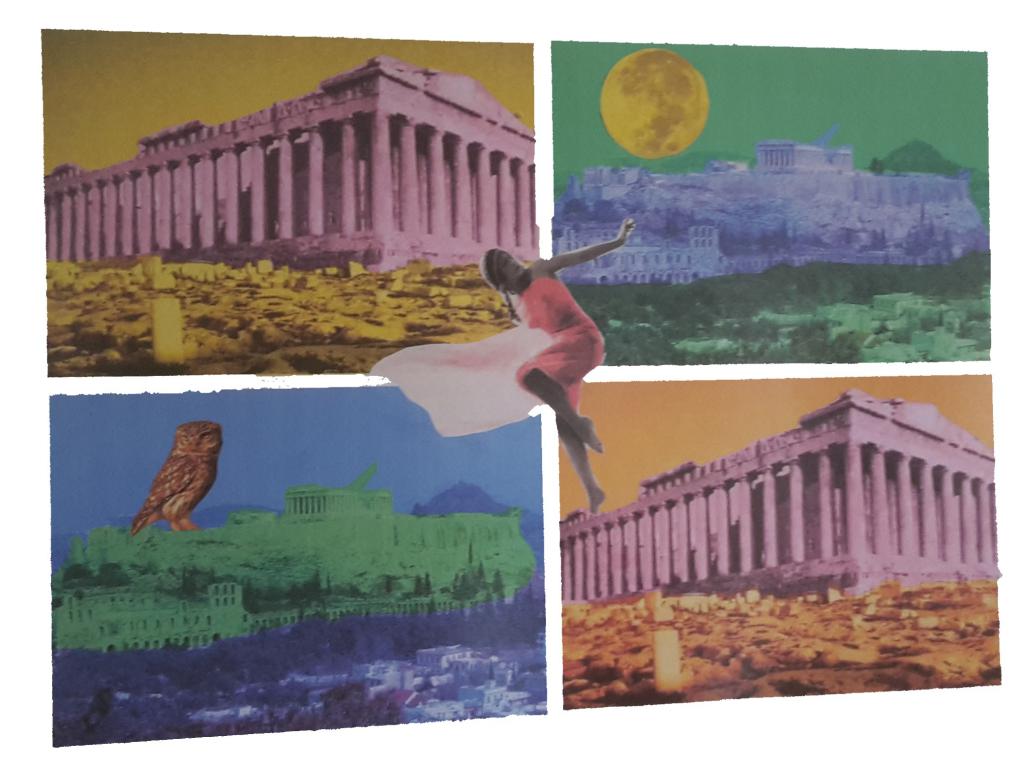
The collage
The following collage is the work of the author of this article and was presented in 2015 at the Peristeri Town Hall in the group exhibition of the Association of Visual Artists of Greece “Apelles.”