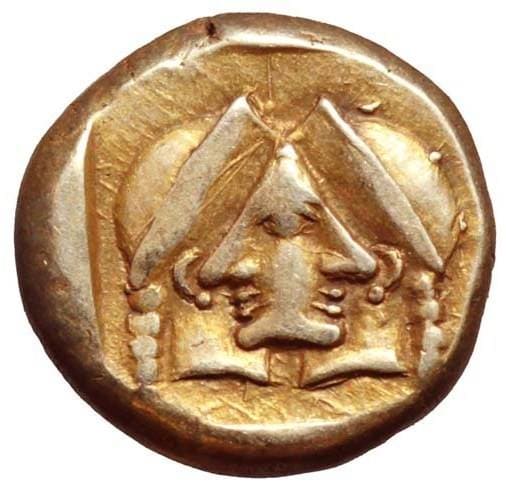
The optical illusion on Greek coins

The below ancient Greek coin of the early classical period contains an “optical illusion”. It comes from the city of Mytilene and dates to the early 5th century B.C. It was made of an alloy of gold and silver, (electrum) and had a value of 1/6th of a stater, known as the “sixth”. On it are printed two opposing faces, in such a way that one face goes inside the other so that the viewer can see each face separately and both together at the same time! This is the only instance of the use of an illusion on ancient Greek coins although they knew the “optical illusion” very well. Another example of this knowledge is the Parthenon, which in order to fool the eye and make it look perfect, the artists Iktinos and Callicrates, under the supervision of Phidias, designed the columns in such a way that each column was different in order to create the illusion of a divine perfection in the temple. (Each pillar has a different slope compared to the others and is made for the specific location in which it was placed. If we mentally extend its columns towards the sky, we will see that they converge at a same point and a pyramid is created.)