Hey guys! I recently made a little puzzle game called Orthecarr (play it at orthecarr.netlify.app for free, full version is at pythonperson.itch.io/orthecarr), and I just wanted to talk a bit about it here.
Orthecarr is a fun game where you follow simple numerical rules (described at http://orthecarr.netlify.app/rules) to create the highest-scoring loop you can in a grid of 5×5 numbers. It’s easy to learn but very tricky to master – I haven’t even gotten a perfect score myself. (Who knows, maybe you can be the first!)
I had an idea for a dozenal (base 12) version of the game, so let me know if that would be interesting. Also I’d love to get some general feedback on it here, so thanks in advance.
When the first typewriters were built, the letters were arranged in alphabetical order. However, because typists struck the keys at great speed, the typebars would often get tangled with each other, causing the machine to jam. To reduce the typing speed and solve this problem, the order of the letters was changed—after years of study—so that letters most frequently used together were placed farther apart. This led to a new layout created by Christopher Latham Sholes, which was named “QWERTY,” after the first letters of the top row on the typewriter. From typewriters, it was then carried over to electronic computers in the form we see on keyboards today. Although in modern times keyboards use elastic membranes instead of metal typebars—so typing speed no longer causes jams—the “QWERTY” layout has now become the standard.
I was hoping some of the fine folks on this forum might share some tools that one can use to create puzzles. I saw a posting about a maze generator (which is sweet!) I’m using both LibreOffice Write and LibreOffice Draw to aid in creating puzzles but I was curious if there other purpose built sorts of tools to aid in creating puzzles. I haven’t Googled it yet but I’d be very surprised if there weren’t tools to help in creating crossword puzzles. I hacked together a small tool to create a “puzzle” of my own invention called a word box but I’m not sure it’s all that interesting.
I send out a monthly newsletter to software developers and as part of the newsletter I attempt to include a puzzle in each edition. I would not consider myself much of a puzzle-master but I do try to come up with original puzzles each month. For the November newsletter I was thinking of sending this puzzle:
It happened a while ago that a census taker was proceeding along a street gathering census information. He finished with number 19 and moved on to the next house. A lady responded to his knock on the door.
“Good afternoon Ma’am. I’m gathering information for the census. Can you please tell me the occupations of yourself and your spouse?”
She responded: “He is a postman. I am a professor of mathematics.”
“Oh, I have some background in math!” said the census taker. “Do you have children?”
“Yes we do!”
“How many of each?”
“If you factor our house number, the larger factor is the number of males in our home and the smaller factor is the number of females (including me) in our home!”
“Excellent! Thank you so much for your time ma’am!” He took a moment to look at the next house to be counted and jotted down both the number of males and females in the math professor’s home.
How many daughters live in the home?
I was hoping for some feedback from the folks here. Is there sufficient information to solve this (I believe it’s called a “minimum information”) puzzle? Any wordsmithing you might do on this? I can share my solution as well; I want to ensure that I haven’t come up with an incorrect solution to the problem I’ve posed 🙂
Any suggestions or comments would be greatly appreciated!
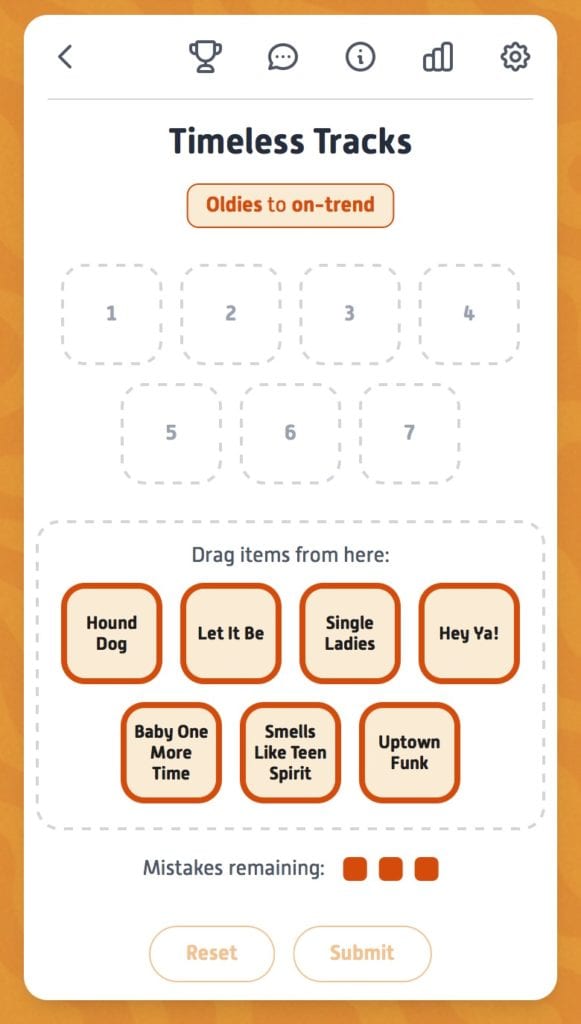
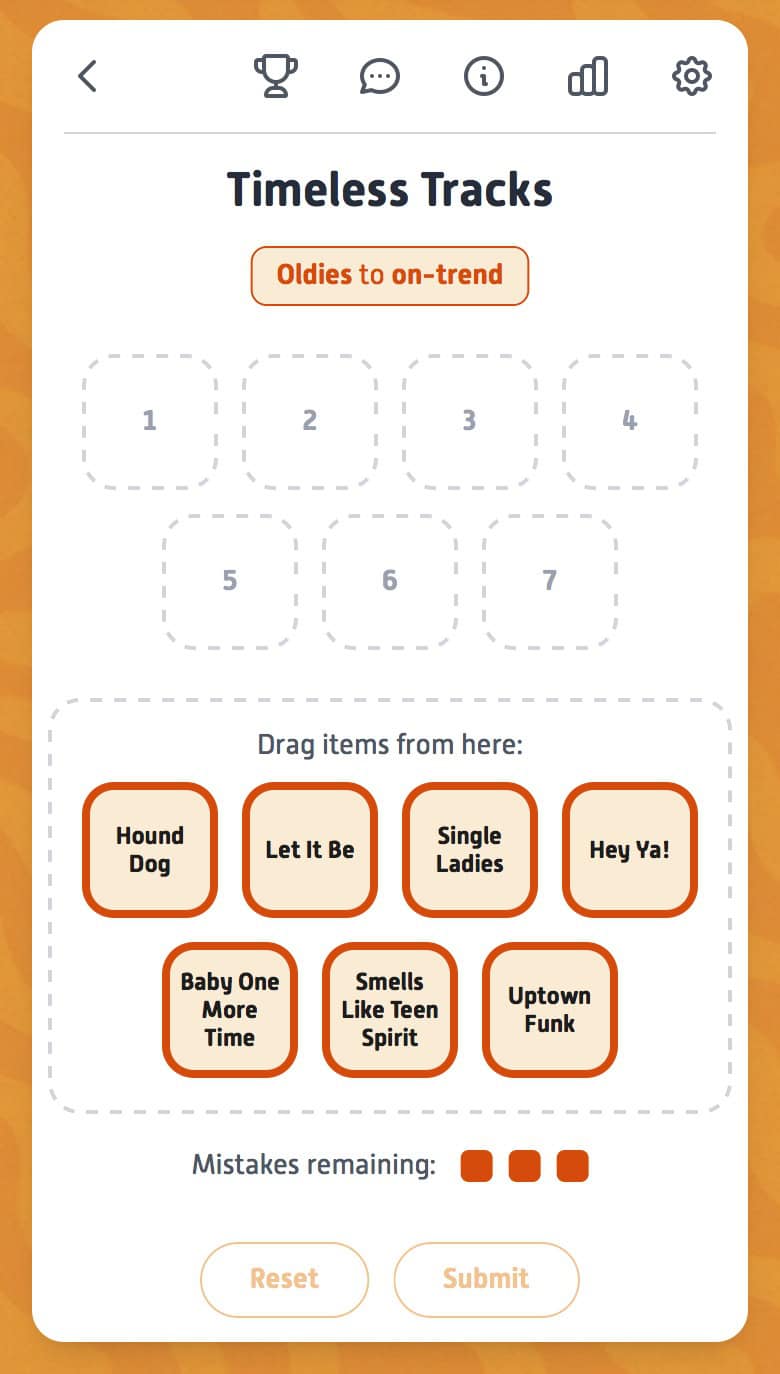
Looking for a new daily puzzle game that’s quick, clever, and free? Meet Lineup — a mix of trivia, brain teasers, and logic puzzles that challenges you to put the world in order.
Every day you get a new puzzle with 5–8 items. Your task? Arrange them in the correct order based on the clue. It could be “books by copies sold,” “planets by size,” or “wars by start date.” Sometimes it’s obvious, sometimes it’s sneaky — but it’s always fun.
✨ What makes it special?
It’s a free puzzle with no ads (finally!)
No signup needed for the first 4 puzzles
Takes only 1–2 minutes to play — perfect with your morning coffee or work break
Track stats, streaks, and rankings once you sign up
Unlock the archive and play past puzzles whenever you like
Lineup is the kind of logic and reasoning puzzle that feels satisfying whether you nail it on the first try or puzzle it out move by move. Think of it as a “matching puzzle meets trivia quiz” — simple, smart, and refreshingly addictive.
If you’re into Wordle, crosswords, or quick online puzzle games, give Lineup a try. A fresh challenge drops every single day.
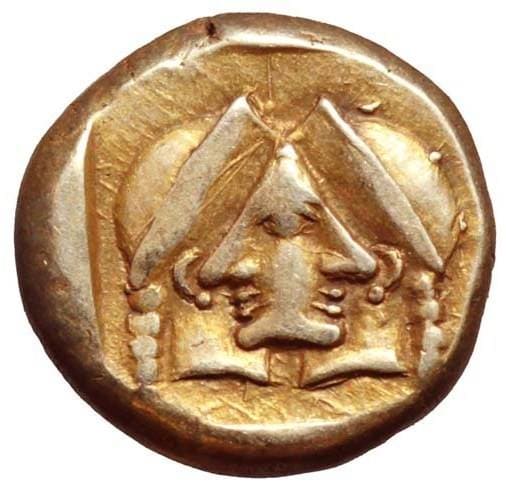
The below ancient Greek coin of the early classical period contains an “optical illusion”. It comes from the city of Mytilene and dates to the early 5th century B.C. It was made of an alloy of gold and silver, (electrum) and had a value of 1/6th of a stater, known as the “sixth”. On it are printed two opposing faces, in such a way that one face goes inside the other so that the viewer can see each face separately and both together at the same time! This is the only instance of the use of an illusion on ancient Greek coins although they knew the “optical illusion” very well. Another example of this knowledge is the Parthenon, which in order to fool the eye and make it look perfect, the artists Iktinos and Callicrates, under the supervision of Phidias, designed the columns in such a way that each column was different in order to create the illusion of a divine perfection in the temple. (Each pillar has a different slope compared to the others and is made for the specific location in which it was placed. If we mentally extend its columns towards the sky, we will see that they converge at a same point and a pyramid is created.)
I’m taking part in a treasure hunt with 16 puzzles divided into 4 groups:
4 photo locations to find
4 text riddles to solve
4 coordinates to decipher
4 coded texts to decode
After solving all 16 we received extra clues in PDF form — a sequence of numbers and cubes, plus symbols for “dot above”, “dot below”, and a slash, exactly in the order shown in the image.
Important clarification: the clues shown in the image refer to the number of the puzzle we solved. For example, a cube indicates puzzle #1, meaning it comes from the first group of four puzzles. Each cube corresponds to the index of the puzzle it came from (so “cube” = puzzle 1, another cube = puzzle 2, etc., mapped to the 1–16 ordering).
We have a theory: by plotting the coordinates of the four locations where we found the same-index clue (for example, the four places where we found clue #1 — one from each group) and then finding the midpoint/centroid of those four points, each set led us to a spot where we found what looks like a fifth poneglyph. At one of those spots we scanned a QR code that said: “find the right moment to capture emotions”.
We think the photo we attached (below) might encode a date and time — i.e., we may need to scan or photograph the QR code at that specific date/time shown in the photo. But we can’t figure out how the remaining part of the code (the numbers, the dot-above / dot-below markers, and the slash) maps to a usable date/time or action.
Our problem: we don’t know how to convert the sequence of numbers + dots + slash into whatever final step is required (date/time, coordinates, or something else).
Any ideas from puzzle solvers or One Piece fans? Any decoding approaches we should try, or examples of similar puzzles where dots mean “AM/PM”, or slashes separate date components, etc.? Thanks in advance — we’ll post the photo and the PDF snippet below.
The following magic square of order 8 was constructed by Benjamin Franklin, the famous scientist and writer of the 1700s.
Notice that each row or column of the magic square has a sum of 260. Also , half of each row or column has a sum of 130. In addition, if we take the halves of the diagonals in twos, “arcs” are formed which all have the same sum which also equals 260.
In many layouts of the square the numbers add up to 260.
The magic square of the apocalypse
It is attributed to A.W.Johnson, of which more details are not known, and is known as the magic square of the apocalypse, (of order 6), as the sum that appears in each column, row and diagonal is 666!!!!
The magic square of the mirror
The following magic square of order 4 has a sum of the numbers of each column, row and both diagonals equal to 176. (Picture 1)
Now, if we were to put a mirror on the left and look at its reflection, we would have a new magic square… (Picture 2)
If we again calculate the sum of the numbers of each column, row and two diagonals, we would again see that it is equal to 176.
If we take the original square again and turn it upside down, we will again have a new magic square, which, if we again calculate the sum of the numbers of each column, row and both diagonals, we will again see that it is equal to 176. (Picture 3)
Now, if we were to put a mirror on the left, and in it, and see its reflection, we would have a new magic square… (Picture 4)
If we again calculate the sum of the numbers of each column, row and both diagonals, we would again see that it is equal to 176.