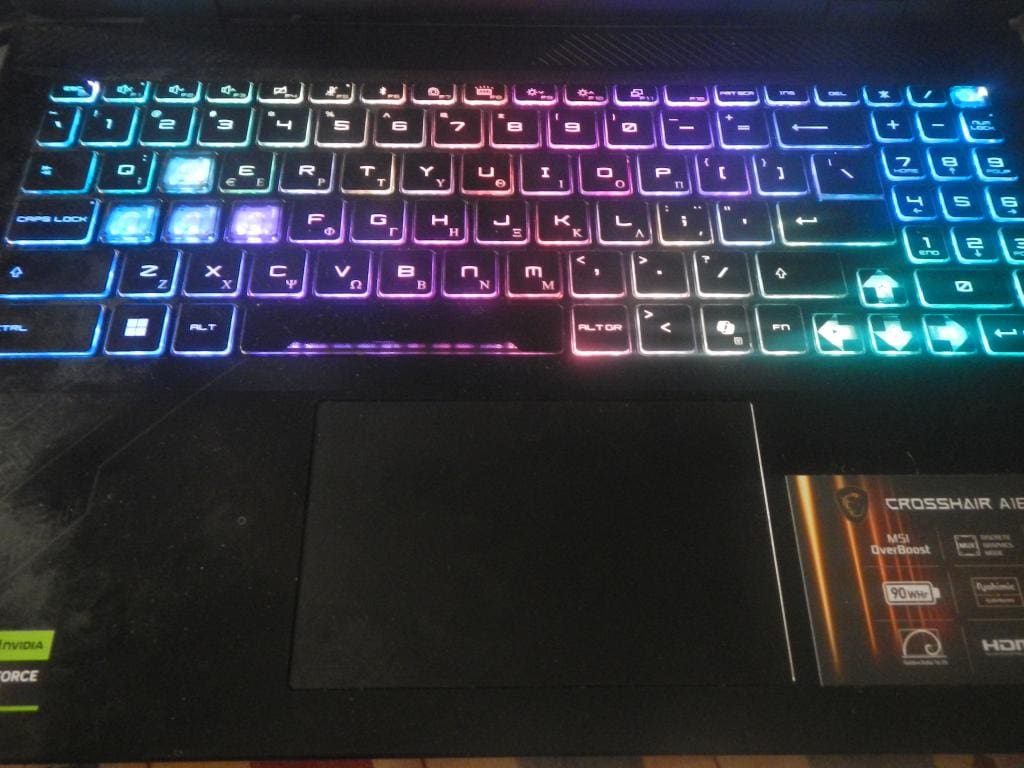
QWERTY Layout: Why aren’t the letters on the keyboard in alphabetical order?

When the first typewriters were built, the letters were arranged in alphabetical order. However, because typists struck the keys at great speed, the typebars would often get tangled with each other, causing the machine to jam. To reduce the typing speed and solve this problem, the order of the letters was changed—after years of study—so that letters most frequently used together were placed farther apart. This led to a new layout created by Christopher Latham Sholes, which was named “QWERTY,” after the first letters of the top row on the typewriter. From typewriters, it was then carried over to electronic computers in the form we see on keyboards today. Although in modern times keyboards use elastic membranes instead of metal typebars—so typing speed no longer causes jams—the “QWERTY” layout has now become the standard.

Tools For Aiding In Creating Puzzles

I was hoping some of the fine folks on this forum might share some tools that one can use to create puzzles.  I saw a posting about a maze generator (which is sweet!) I’m using both LibreOffice Write and LibreOffice Draw to aid in creating puzzles but I was curious if there other purpose built sorts of tools to aid in creating puzzles.  I haven’t Googled it yet but I’d be very surprised if there weren’t tools to help in creating crossword puzzles.  I hacked together a small tool to create a “puzzle” of my own invention called a word box but I’m not sure it’s all that interesting. 

The optical illusion on Greek coins

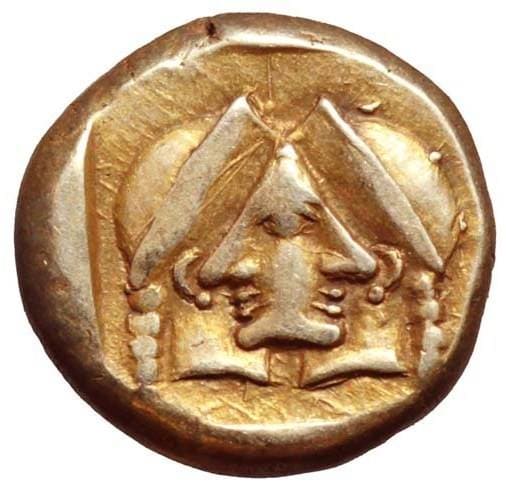
The below ancient Greek coin of the early classical period contains an “optical illusion”.  It comes from the city of Mytilene and dates to the early 5th century B.C. It was made of an alloy of gold and silver, (electrum) and had a value of 1/6th of a stater, known as the “sixth”. On it are printed two opposing faces, in such a way that one face goes inside the other so that the viewer can see each face separately and both together at the same time! This is the only instance of the use of an illusion on ancient Greek coins although they knew the “optical illusion” very well. Another example of this knowledge is the Parthenon, which in order to fool the eye and make it look perfect, the artists Iktinos and Callicrates, under the supervision of Phidias, designed the columns in such a way that each column was different in order to create the illusion of a divine perfection in the temple.  (Each pillar has a different slope compared to the others and is made for the specific location in which it was placed. If we mentally extend its columns towards the sky, we will see that they converge at a same point and a pyramid is created.)

Gordian knot

The Gordian Knot was the intricate knot that was tied to the chariot of King Gordius, who was the father of Midas.  Gordius had seen an eagle sitting on the yoke of the chariot he was ploughing and took it as an omen, and later when he confessed to a girl who was a fortune teller what had happened, she told him when he came to Phrygia with the chariot, to sacrifice to Zeus. Gordius fell in love with her, married her and had a son Midas. An oracle said that the Phrygians would have to make a king who would come to the country in a chariot, in order to stop the civil war between them. So when Gordius came with his wife and his son Midas to this place, they made him king of Phrygia, and he stopped the rebellion. Later he was succeeded by his son,  Midas. To honor Zeus, in addition to the necessary sacrifice, Gordios left his chariot as a tribute to the god. The chariot was tied with a rope of skull bark to the old palace of the kings of Phrygia, in the city of Gordian, and no one could untie it. Tradition said that whoever untied it would rule Asia.  When Alexander the Great arrived in Gordium, he heard about the Gordian Knot, examined it and managed to untie it. One version says that he took his sword and cut it saying: “what cannot be untied, can be cut.” This, although it is the most popular version, is the least likely. Another version, according to Arrian and Plutarch, say that there was an eyewitness, Aristobulus, who saw that Alexander the Great, simple took the pin out of the steering wheel of the chariot and the knot that held on it, untied by itself. Today when we say that a problem is like the “Gordian Knot” we mean that it is a difficult and intractable problem. (But which can either have a very simple solution, or it will take extreme measures to solve it).

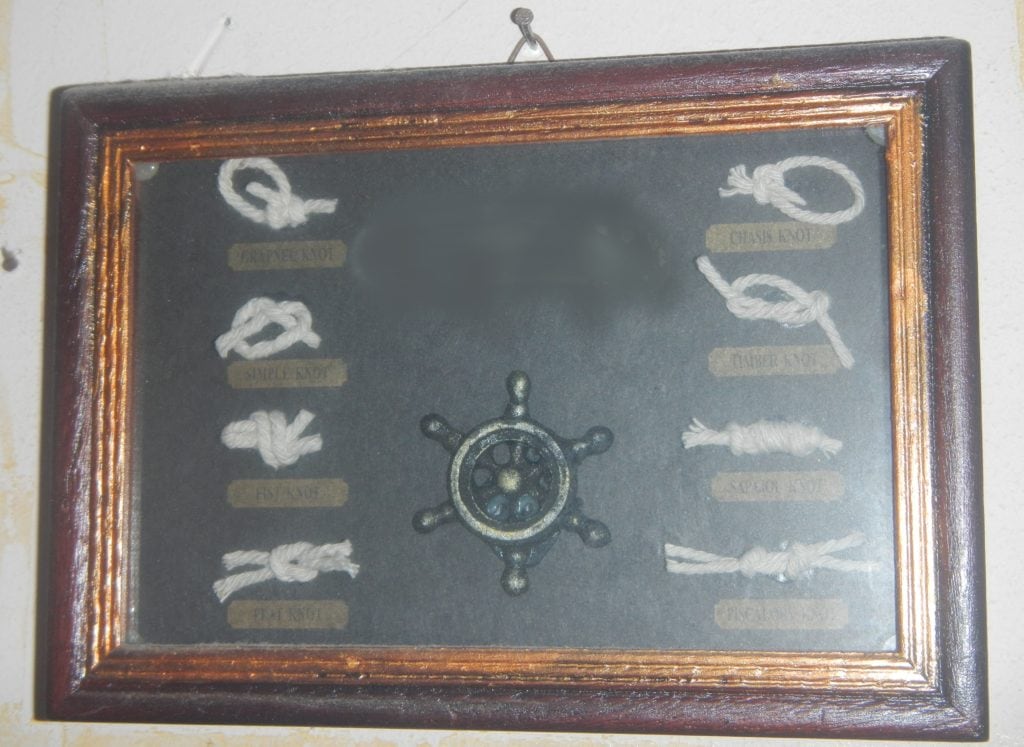
The image below shows some nautical knots.

The “ΙΧΘΥΣ” Christian symbol.

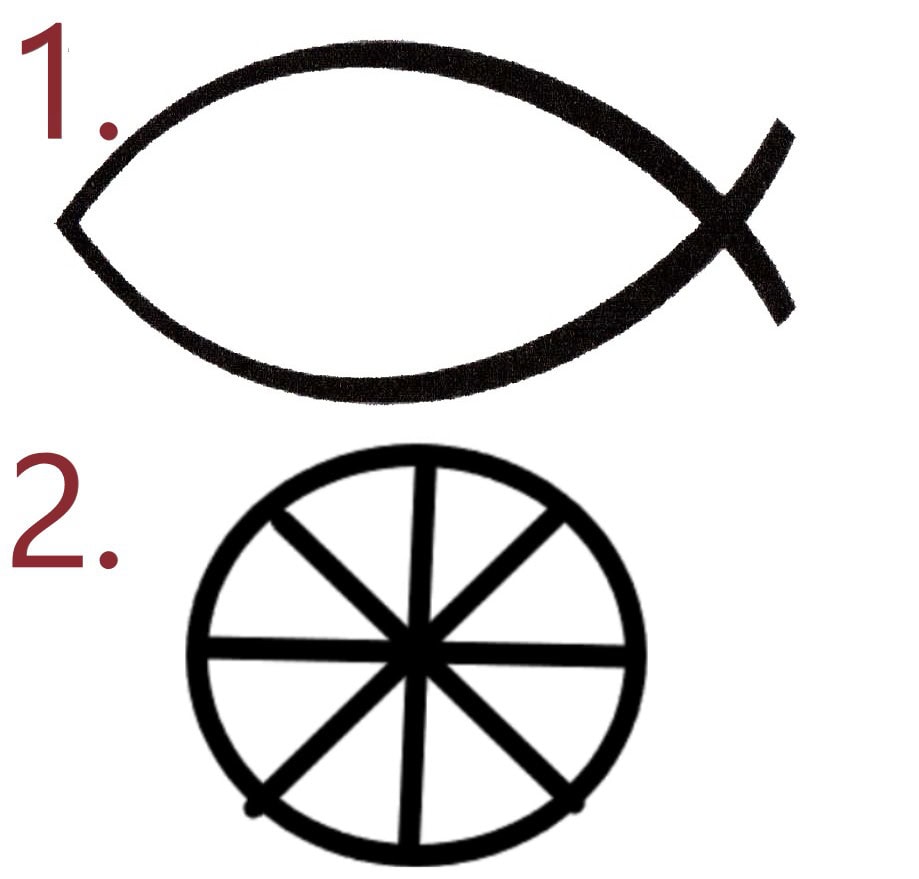
The ichthys or ichthus symbol (picture 1), from the Greek word “ΙΧΘΥΣ” which means fish, was adopted by early Christians as a secret symbol to recognize each other. This was needed because of the Christian prosecution at the time by the Roman Empire.

ἸΧΘΥΣ or also ἸΧΘΥϹ with a lunate sigma, is an acronym for “Ἰησοῦς Χρῑστός Θεοῦ Υἱός Σωτήρ”, Iēsoûs Khrīstós, Theoû Huiós,  sōtḗr which translates into English as ‘Jesus Christ, God’s Son, Savior’.

 Ι : Iota (i), Iēsoûs (Ἰησοῦς), “Jesus”

Χ: Chi (ch), Khrīstós (Χρῑστός), “anointed”

Θ: Theta (th), Theoû (Θεοῦ), “of God”, the genitive singular of Θεóς, Theós, “God”

Υ: Ypsilon (y or u), (h)uiós (Yἱός), “Son”

Σ or C: Sigma (s), sōtḗr (Σωτήρ), “Savior”

Another way to represent the word fish is the symbol in picture 2.

CAN YOU LOCATE ALL 5 LETTERS OF THE WORD «ΙΧΘΥΣ» (or “ΙΧΘΥC”) IN THIS SYMBOL?

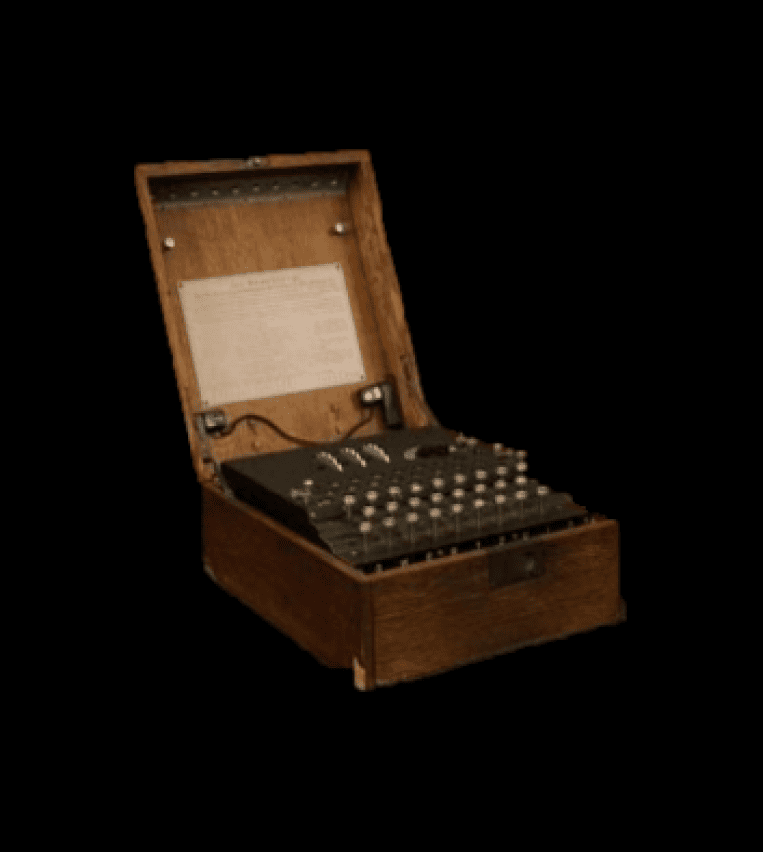
The “Enigma” device, in World War II

During World War II the Germans exchanged coded messages with the “Enigma” device. It was a typewriter-like device that had one sender and one receiver. This machine changed the letters you typed with other letters. If you typed the letter F, for example, the letter S was printed. But if you typed the letter F again, it was not the letter S that was printed, but a different letter was printed. The correspondence of the letters changed with each typing. In order for the recipient to decipher the message, he had to have placed some wiring and some components of this machine in the same way as the sender had placed them. The Germans changed the wiring and components at regular intervals, so even if the Allies had the “Enigma” machine, if they did not know the correct placement they were unable to decipher the messages they intercepted.


The British turned to the mathematician Alan Turing who was known for his work on “algorithms” and the famous “Turing machine“, which was theoretically capable of calculating anything that could be calculated algorithmically.


Turing formed the Group of “Hut 8” who, without breaks and sleep, in a secret location, tried to crack the code of the “Enigma” machine. For this purpose they built the first digital computer, the “Colossus Mark I” which was much larger than a whole room. Alan Turing is considered the father of today’s computers.


The “Hut 8” team had not made significant progress until someone on the team thought that if they had an array of consecutive letters they could more easily decode the messages they were intercepting. Then, by taking a closer look at these messages, they noticed that at the end of each message two words were repeated in all of them. Then they realized that those words were the phrase: “High Hitler”. That was it. They set up the “Colossus Mark I” based on those words and cracked the code. This success was kept secret and played a significant  part  in the positive outcome of the war.


After the war, on February 19, 1946, Turing presented the first complete design of a computer.


In 1949 he worked on the software for one of the first computers, the “Manchester Mark H”. He also worked on the idea of artificial intelligence, and proposed an experiment known today as the “Turing Test” to determine when a machine could be called “intelligent”.


The end of Turing: In 1952, after a betrayal by his lover, Turing was accused of “sexual perversion” and “homosexuality”. In court, he did not defend himself. His sentence was either to go to jail or have estrogen injections for a year. He accepted the second and continued his research on morphogenesis, quantum theory and relativity.


Turing committed suicide on 7 June 1954 at the age of 42 by eating an apple containing cyanide. It is rumored that the company “Apple” created the logo with the bitten apple to honor his memory. 

Sissa and Chess

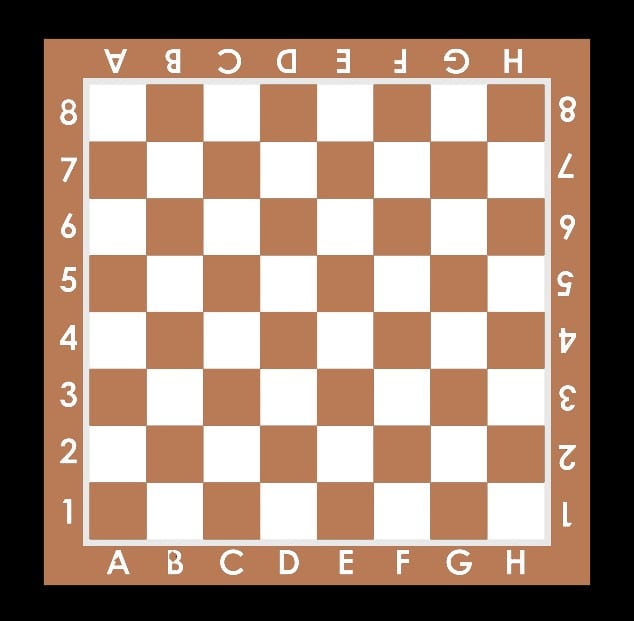
There are many opinions about from who, where and when chess was created. The most widespread opinion is that it was created by the Brahmin Sissa. When he presented it to the ruler of the region where he lived, he was so charmed that he said he would give him any reward he wanted… Sissa asked him for as much grain as would be needed to fill the 64 squares of the chessboard, if they placed one grain in the first square, two grains in the second, four in the third, etc., doubling the grains each time until they reached square 64. The ruler, who considered the quantity of grain insignificant, told him to ask for something more important. But when Sissa insisted, he asked the treasurer and storehouse manager to give him the amount of wheat he requested. But when the treasurer calculated the number, he told the king that even if all the land on the whole planet had been sown with wheat, it would not be enough to pay him, because the total wheat that would be needed amounted to the astronomical amount of 18,446,744,073,709,551,616 grains!

Visit Ragnar’s Riddles on LinkedIn

Join Ragnar’s Riddles group “Inspired by the Pure Heart of a Black Cat” on LinkedIn

Some wisdom comes in whispers, carried on silent paws through the night. This group is inspired by Ragnar, a stray black cat who appeared one cold winter’s day—wounded, wary, and wise beyond words. He carried with him a test, a journey, and a gift: the ancient riddles of the cosmos, hidden in the resilience of those who dare to seek truth.

Here, we explore the mysteries of the universe through Ragnar’s Riddles—stories of healing, wisdom, and unseen connections. Each puzzle is a challenge, a call to see beyond the ordinary, to care for the forgotten, and to rise against darkness.

Do you hear the whispers of the eternal? Are you ready to solve the riddles that guide us toward balance and meaning?

Join us and step into the mystery:
https://www.linkedin.com/groups/10037000

“In shadow I tread, with scars in my wake,
A voice from the stars, for hearts that ache…”
– Ragnar the black cat 🐈‍⬛ and Igor the caretaker wizard 🧙

Alternatively search using #RagnarsRiddles

The Promotion Dilemma

A company has two equally skilled employees, Alex and Jordan. One day, the boss announces that only one of them will be promoted based on their creativity. The next morning, Jordan walks into the office with a simple yet brilliant idea, and immediately gets the promotion. What did Jordan do?

A) Jordan invented a new product overnight
B) Jordan redesigned the company’s logo
C) Jordan changed their email signature
D) Jordan solved a major workflow issue

Why do analog clocks in advertisements usually show 10:10?

This is not done by chance but for aesthetic reasons.
Advertisers came up with this because, according to communicators,
they make the product more attractive:
1. This hour creates a sense of isometry.
2. Subconsciously the pointers remind you of a smile,
thus creating a feeling of pleasure, while on the contrary if it
were 8:20 they would remind you of a willful face which would create
the corresponding unpleasant feeling.
3. The hands appear to embrace the watch brand’s logo which is usually
located below the number 12.
4. Allows you to read other watch indications such as date, timer and more…
Some brands to differentiate show 10:08 or 10:09 or 10:11.

(In the first television watch commercial in 1941 in the USA,
for the Bulova company, which was also the first television
commercial in history, the clock showed exactly 8.)