
Beautiful Tapestry

A piece of a beautiful tapestry is missing. Can you figure out what its colors are?
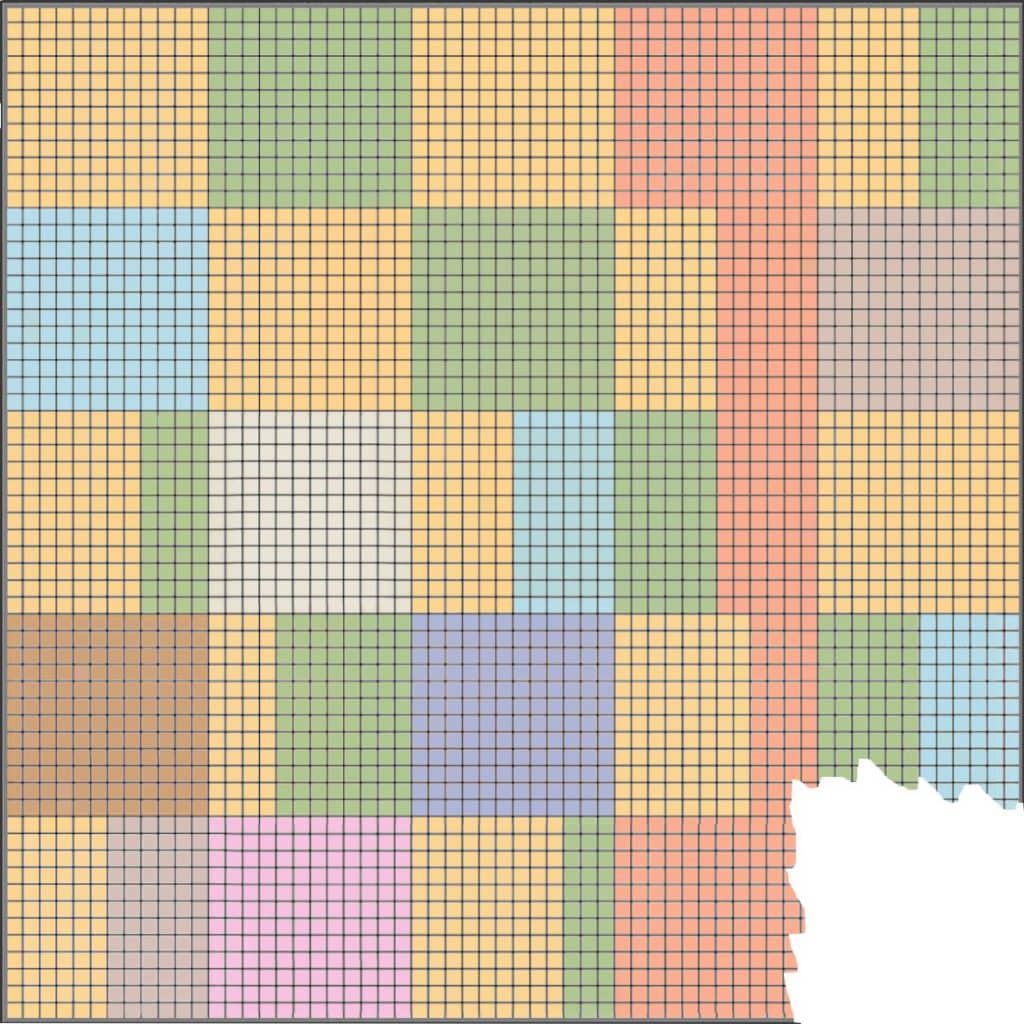
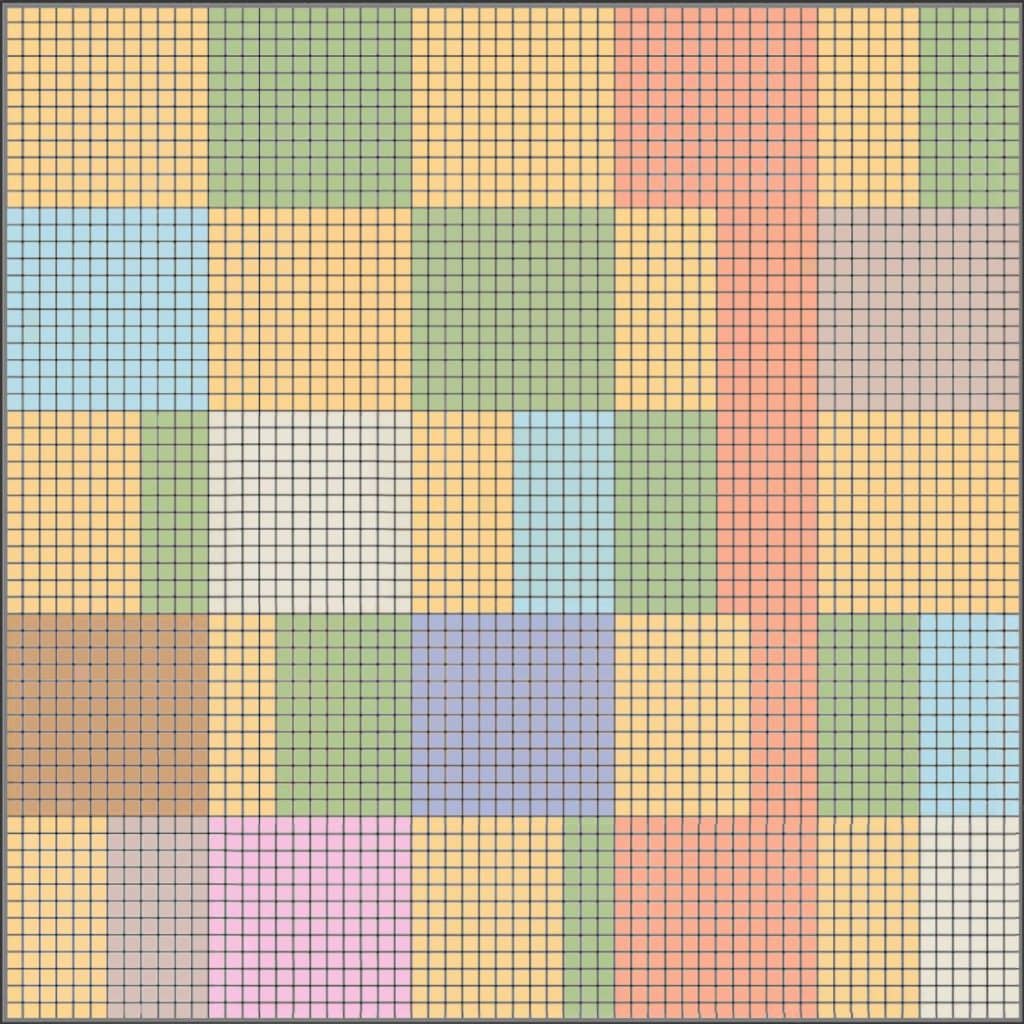
The tapestry represents the factorizations of the numbers from 2 to 26.

Each 12×12 square on the tapestry represents a number between 2 and 26, such that all squares representing prime numbers are painted in single colors. The colors of the squares representing composite numbers are determined by the factors of these numbers.

The number 2 is represented by orange color (top left corner). The number 3 is represented by green color. The number 4 = 2×2 is represented once again by orange (2, 2) color. The number 5 is represented by red color. The number 6 = 2×3 is represented by orange (2) and green (3) colors. The number 7 is represented by blue color. The number 8 = 2×2×2 is represented once again by orange (2, 2, 2) color. The number 9 =3×3 is represented once again by green (3, 3) color. The number 10 = 2×5 is represented by orange (2) and red (5) colors, and so on.
FEATURED

Does Not Divide Another

How many numbers between 1 and 100 can you pick at most, so that none of them divide another?

You can choose fifty numbers at most: 51, 52, 53, … , 100.

In order to see that you cannot choose more than fifty, express each number in the form 2ⁿ×m, where m is an odd number. Since no two numbers can have the same m in their expressions, and there are only fifty odd numbers between 1 and 100, the statement of the problem follows.

Murdered Wife

One night, a man received a call from the Police. The Police told the man that his wife was murdered, and that he should get to the crime scene as soon as possible. The man immediately hung up the phone and drove his car for 20 minutes. As soon as he got to the crime scene, the Police arrested him, and he got convicted for murder.

How did the Police know that the man committed the crime?

The police did not tell the man where the crime scene was.

Self-Describing Number

Find all 10-digit numbers with the following property:

  • the first digit shows the number of 0s in the number
  • the second digit shows the number of 1s in the number
  • the third digit shows the number of 2s in the number, and so on

Let the number be ABCDEFGHIJ. The number of all digits is 10:

A + B + C + D + E + F + G + H + I + J = 10

Therefore, the sum of all digits is 10. Then:

0×A + 1×B + 2×C + 3×D + 4×E + 5×F + 6×G + 7×H + 8×I + 9×J = 10

We see that F, G, H, I, J < 2. If H = 1, I = 1, or J = 1, then the number contains at least 7 identical digits, clearly 0s. We find A > 6 and E = F = G = 0. It is easy to see that this does not lead to solutions, and then H = I = J = 0.

If G = 1, we get E = F = 0. There is a 6 in the number, so it must be A. We get 6BCD001000, and easily find the solution 6210001000.

If G = 0, F can be 0 or 1. If F = 1, then there must be a 5 in the number, so it must be A. We get 5BCDE10000. We don’t find any solutions.

If F = 0, then the number has at least five 0s, and therefore A > 4. However, since F = G = H = I = J = 0, the number does not have any digits larger than 4, and we get a contradiction.

Thus, the only solution is 6210001000.

FEATURED

Five Points in a Square

There are 5 points in a square 1×1. Show that 2 of the points are within distance 0.75.

Split the unit square into 4 small squares with side lengths 0.5. At least one of these squares will contain 2 of the points. Since the diagonals of the small squares have lengths less than 0.75, these 2 points must be within such distance.

Fish in a Pond

There are 5 fish in a pond. What is the probability that you can split the pond into 2 halves using a diameter, so that all fish end up in one half?

Let us generalize the problem to N fish in a pond. We can assume that all fish are on the boundary of the pond, which is a circle, and we need to find the probability that all of them are contained within a semi-circle.

For every fish Fᵢ, consider the semi-circle Cᵢ whose left end-point is at Fᵢ. The probability that all fish belong to Cᵢ is equal to 1/2ᴺ⁻¹. Since it is impossible to have 2 fish Fᵢ and Fⱼ, such that the semi-sircles Cᵢ and Cⱼ contain all fish, we see that the probability that all fish belong to Cᵢ for some i is equal to N/2ᴺ⁻¹.

When N = 5, we get that the answer is 5/16.

Pronunciation Puzzles

The following 2 puzzles rely on misleading phrasing of the questions. Read them aloud to your friends and let them ponder upon them.

  1. What has 4 letters, sometimes 9, and never 5
  2. One night a king and a queen stayed in a hotel. On the next day, three people checked out. Who was the third person?
  3. There are 30 cows and 28 chickens. How many didn’t?
  4. Pronounce the following words: T-W-A, T-W-E, T-W-I, T-W-O
  5. As I was walking across the London Bridge, I met a man.
    He tipped his hat, and drew his cane.
    In this riddle, I said his name. What is it?

The first puzzle is not a question. It is a statement, saying that the word “what” has 4 letters, the word “sometimes” has 9 letters, and the word “never” has 5 letters. There is nothing to solve, so the puzzle is figuring that out!

The second puzzle reads as “One knight, a king, and a queen stayed in a hotel.” Thus, the third person was the knight.

The third puzzle reads as “There are 30 cows and 20 ate chickens. How many didn’t?” Thus, the answer is that 10 cows didn’t eat chickens.

The fourth question often confuses people and they pronounce TWO as [twou] instead of [tuː].

The fifth riddle actually says: “He tipped his hat, ‘Andrew Hiscane'”. Thus, the name of the man is Andrew Hiscane.