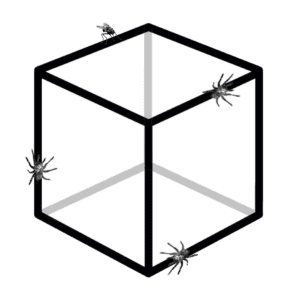
There are a fly and three spiders on the edges of a cube. If the spiders’ velocities are at least 1/3 of the fly’s velocity, and all insects can travel only along the edges of the cube, show that the spiders can eventually catch the fly.
SOLUTION
Choose two opposite edges of the cube, then let two of the spiders “protect” them from the fly. You can do this by keeping the distance from the two spiders to the edges’ endpoints at most 1/3 of the distance from the fly to these endpoints. The remaining parts of the cube do not contain any loops, so the third spider can easily catch the fly there.
There are only two barbers in one town. One of the barbers has a neat haircut and a clean working place. The other barber’s haircut is a total mess and his working place is dirty. Which barber would you choose to give you a haircut and why?
SOLUTION
You should choose the second barber. Since there are only two barbers, the chances are that they give each other haircuts. Also, probably the second barber’s salon is dirtier because he has lots of work and does not have time to clean up properly.
There are 25 horses and you want to find the fastest 3 among them. You can race any 5 of the horses against each other and see the final standing, but not the running times. If all the horses have constant, permanent speeds, how many races do you need to organize in order to find the fastest 3?
SOLUTION
Let us label the horses H1, H2, H3, H4, …, H24, H25.
We race H1 – H5 and (without loss of generality) find that H1 > H2 > H3 > H4 > H5. We conclude that H4, H5 are not among the fastest 3.
We race H6 – H10 and (without loss of generality) find that H6 > H7 > H8 > H9 > H10. We conclude that H9, H10 are not among the fastest 3.
We race H11 – H15 and (without loss of generality) find that H11 > H12 > H13 > H14 > H15. We conclude that H14, H15 are not among the fastest 3.
We race H16 – H20 and (without loss of generality) find that H16 > H17 > H18 > H19 > H20. We conclude that H19, H20 are not among the fastest 3.
We race H21 – H25 and (without loss of generality) find that H21 > H22 > H23 > H24 > H25. We conclude that H24, H25 are not among the fastest 3.
We race H1, H6, H11, H16, H21 and (without loss of generality) find that H1 > H6 > H11 > H16 > H21. We conclude that H16, H21 are not among the fastest 3.
Now we know that H1 is the fastest horse and only H2, H3, H6, H7, H11 could complete the fastest three. We race them against each other and find which are the fastest two among them. We complete the task with only 7 races in total.
How many places are there on Earth so that if you travel 1 mile South, followed by 1 mile East, followed by 1 mile North, you will get back where you started from?
Remark: You can assume Earth is a perfect globe.
SOLUTION
The answer is infinitely many. Of course, the North Pole is one such place. However, if you start close to the South Pole, such that after traveling 1 mile South you land on a parallel with total length of 1/N miles, N-integer number, then when traveling East you will encompass this parallel exactly N times and later will get back to the starting place. These are all places with the property described above.
A man must mail a precious necklace to his wife, but anything sent through the mail will be stolen unless it is sent in a padlocked box. A box can bear any number of padlocks, but neither of the spouses has the key to a lock owned by the other. How can the husband mail the necklace safely to his wife?
SOLUTION
The man can put a lock on the box and send it to his wife. Then she can put her own lock and send it back. Once the man receives the box, he can remove his lock and send the box once again to his wife. When she gets it, she can finally unlock the box using her own key.
On the picture, you can see an example of a wall made of 2×1 bricks. On the wall, there are 2 cracks, which are straight lines passing through the whole wall from top to bottom and from left to right, without intersecting any bricks.
Can you make the following walls without any cracks:
wall 5×6 with 15 bricks;
wall 6×6 with 18 bricks?
SOLUTION
The solution for a 5×6 wall is shown below. However, if the wall has dimensions 6×6, it is impossible to build it without any cracks. Indeed, assume the wall does not have any cracks. Therefore every line passing through it must intersect 2, 4, or 6 bricks. Since there are in total 10 lines passing through the wall and each brick is intersected by exactly one of them, the total number of bricks must be at least 10 x 2 = 20 > 18. This yields a contradiction.
A large rectangle is partitioned into smaller rectangles, each of which has integer length or integer width. Prove that the large rectangle also has integer length or integer width.
SOLUTION
This problem can be solved using graph theory, but the most elegant solution is based on some basic calculus.
Place the big rectangle in the plane so that its sides are parallel to the X and Y axes. Now integrate the function f(x)=sin(πx)sin(πy) over the boundary of any small rectangle. Since at least one of its sides has integer length, the result will be 0. If you sum all integrals taken over the boundaries of the small rectangles and cancel the opposite terms, you will get that the integral of f(x) over the boundary of the large rectangle is also equal to 0. Therefore at least one of its sides has integer length.