Two friends are playing the following game – taking turns, they place identical coins on a square table, so that no two coins touch each other. Whoever can not make a move, loses the game. Who has a winning strategy?
SOLUTION
The first player has a winning strategy. He just has to place the first coin in the center of the table and then each consecutive one symmetrically opposite to the last coin of his opponent.
You get shrunk 100 times (preserving your density), then thrown in a blender. You have 2 minutes until the blades of the blender start spinning. How are you going to escape?
SOLUTION
If you get shrunk 100 times, but your density remains the same, your muscles will become so strong relative to your size, that you will be able to jump out of the blender. The reason is that your weight will decrease 1000000 times, but your muscle cross-section just 10000 times.
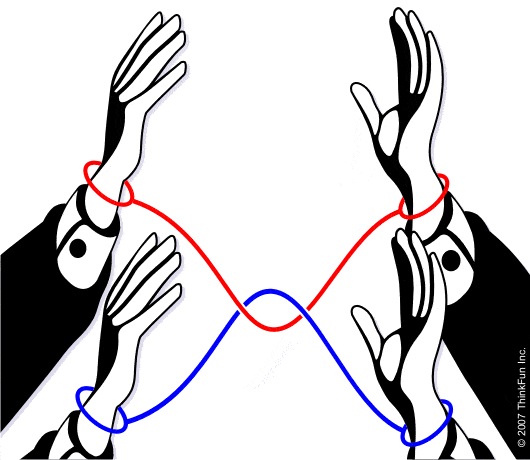
Get 2 ropes and tie them up around the hands of 2 of your friends, as shown on the picture. Then, let your friends separate from each other, without untying the knots or cutting the ropes.
This puzzle/game is played with groups of people, in which some of the participants know the rules, and others are trying to figure them out.
All players must sit in a circle, facing each other. Then one person who is familiar with the rules starts by pointing at another and saying “cross-cross”, “cross-parallel”, “parallel-cross”, or “parallel-parallel”. After that, the person who got picked must choose another one and guess which one of the four expressions above he must say. If he gets it wrong, he gets corrected, and then the next person continues. The game ends when everyone finds out what the secret is.
To play this puzzle game with your friends, at least one of you must know the secret rules and solution, which are explained below. Just keep in mind that whoever learns the rules, will lose the enjoyment of figuring them out by himself.
SOLUTION
When you point at somebody, you say “cross-cross”, if yours and the other person’s legs are crossed, “cross-parallel”, if yours are crossed and the other person’s are parallel, etc.
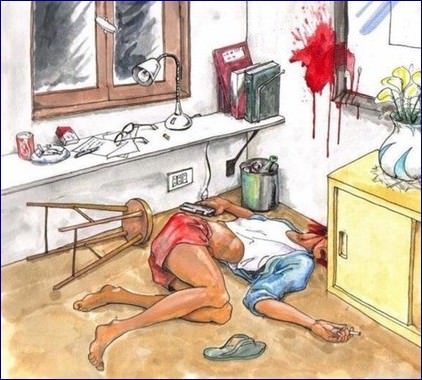
Examine the picture and determine whether the woman was killed or she committed a suicide.
SOLUTION
This was a murder, which was supposed to look like a suicide. These are some of the reasons:
1. The dead person has not finished their cigarette yet, which is a normal thing to do when someone commits a suicide. 2. The person is left-handed, judging by the position of the pen and the lamp, but is holding the gun in their right hand. 3. It was supposed to look like the person was writing a death note before killing themselves, but it is night and the lamp is not plugged in.
Once there was a recluse who always stayed in his home. The only time anyone visited him was when his food and supplies were delivered, but nobody came inside. One winter night there was a big storm and the recluse had a nervous breakdown. He went to his room, turned off all the lights and got in his bed. The next morning he found out that he caused the deaths of several hundred people. How?
SOLUTION
The recluse was living in a lighthouse. When he turned off the lights, he caused several ships to get wrecked in the cliffs and many people die.
On the table in front of you there is a square with 4 coins placed on its vertices. You are blindfolded and are given the task to turn all of the coins with either heads up or tails up. Every time you turn few of the coins however, the square rotates arbitrarily on the table. Find a strategy, such that no matter the starting arrangement of the coins and no matter how the square rotates after every flip of coins, eventually you will turn all of the coins with the same face up.
SOLUTION
First assume that there is even number of tails and even number of heads on the table – 2 of each kind. Flip 2 opposite coins. If after that not all coins have the same face up, the coins’ faces along the square’s corners show T-T-H-H. Now flip 2 adjacent coins. If after that not all coins have the same face up, the coins’ faces along the square’s corners show T-H-T-H. Now flip again 2 opposite coins and you are done.
Next assume that there were intially odd number of tails and odd number of heads on the table. Then after applying the moves described above, flip one of the coins upside down. Now there is even number of heads and even number of tails on the table, so you can repeat the same procedure and accomplish the task.
How can you throw a ball and have it come back to you, even though the ball is not attached to anything, doesn’t bounce off anything and nobody catches it and throws it back to you?
You have 15 identical coins – 2 of them made of pure gold and the other 13 made of nickel (covered with thin gold layer to mislead you). You also have a gold detector, with which you can detect if in any group of coins, there is at least one gold coin or not. How can you find the pure gold coins with only 7 uses of the detector?
SOLUTION
First, we note that if we have 1 gold ball only, then we need:
1 measurement in a group of 2 balls
2 measurements in a group of 4 balls
3 measurements in a group of 8 balls
Start by measuring 1, 2, 3, 4, 5.
If there are gold balls in the group, then measure 6, 7, 8, 9, 10, 11.
If there are gold balls in the group, then measure 5, 6, 7.
If there are no gold balls among them, then there is a gold ball among 1, 2, 3, 4, and a gold ball among 8, 9, 10, 11, so we can find the gold balls with the remaining 2 measurements.
If there are gold balls in 5, 6, 7, then measure 5, 8, 9. If there are gold balls there, then 5 must be gold, and we can find the other gold ball among 6, 7, 8, 9, 10, 11 with the remaining 3 measurements. If there is no gold ball among 5, 8, 9, then there is a gold ball among 1, 2, 3, 4, and a gold ball among 6, 7, so again we can find them with only 3 measurements.
If there are no gold balls in the group, then measure 5, 12, 13.
If there are no gold balls among them, then measure 14, 15. If none of them is gold, then measure individually 1, 2, and 3 to find which are the 2 gold balls among 1, 2, 3, 4. Otherwise, there is a gold ball among 1, 2, 3, 4, and among 14, 15, and we can find them with the remaining 3 measurements.
If there are gold balls among 5, 12, 13, then measure 5, 14, 15. If none of them is gold, then there is a gold ball among 1, 2, 3, 4, and a gold ball among 12, 13, so we can find them with 3 measurements. Otherwise, 5 is gold, and again we can find the other gold ball among 1, 2, 3, 4, 12, 13, 14, 15 with 3 measurements.
If there are no gold balls among 1, 2, 3, 4, 5, then we measure 6, 7, 8.
If there are gold balls in the group, then measure 9, 10, 11, 12, 13.
If there are no gold balls among them, we measure individually 6, 7, 8, 14.
If there is a gold ball among 9, 10, 11, 12, 13, then there is another one among 6, 7, 8. We measure 8, 9. If none of them is gold, then we can find the gold among 6, 7, and the gold among 10, 11, 12, 13, with 3 measurements total. If there is a gold ball among 8, 9, then we measure 10, 11, 12, 13. If none of them is gold, then 9 is gold and we find the other gold ball among 6, 7, 8 with 2 more measurements. If there is a gold ball among 10, 11, 12, 13, then we can find it with 2 measurements. The other gold ball must be 8.
If there are no gold balls in the group, then measure 9, 10.
If there are no gold balls among them, then measure individually 11, 12, 13, 14.
If there are gold balls among 9, 10, then measure 11, 12, 13, 14. If there is a gold ball among them, then there is another one among 9, 10, and we can find them both with 3 measurements. Otherwise, we measure 9 and 10 individually.