
Students with Hats

Professor Vivek decided to test three of his students, Frank, Gary and Henry. The teacher took three hats, wrote on each hat a positive integer, and put the hats on the heads of the students. Each student could see the numbers written on the hats of the other two students but not the number written on his own hat.

The teacher said that one of the numbers is sum of the other two and started asking the students:

— Frank, do you know the number on your hat?
— No, I don’t.
— Gary, do you know the number on your hat?
— No, I don’t.
— Henry, do you know the number on your hat?
— Yes, my number is 5.

What were the numbers which the teacher wrote on the hats?

The numbers are 2, 3, and 5. First, we check that these numbers work.

Indeed, Frank would not be able to figure out whether his number is 2 or 8. Then, Gary would not be able to figure out whether his number is 3 or 7, since with numbers 2, 7, 5, Frank still would not have been able to figure his number out. Finally, Henry can conclude that his number is 5, because if it was 1, then Gary would have been able to conclude that his number is 3, due to Frank’s inability to figure his number out.

Next, we we check that there are no other solutions. We note that if the numbers are 1, 4, 3, or 3, 2, 1, or 4, 1, 3, neither Frank nor Gary would have been able to figure their number out. Therefore, if the numbers were 1, 4, 5, or 3, 2, 5, or 4, 1, 5, Henry would not have been able to figure his number out. Thus, 5 is not the largest number.

Similarly, if the numbers are X, X + 5, X + 10, or X + 5, X, X + 10, once again, neither Frank nor Gary would have been able to figure their number out. Therefore, if the numbers were X, X + 5, 5, or X + 5, X, 5, Henry would not have been able to figure his number out.

The Ping Pong Puzzle

Three friends – A, B, and C, are playing ping pong. They play the usual way – two play at a time, the winner stays on the table, the loser lets the third one play. If you know that A played 10 matches in total, B played 15 matches in total, and C played 17 matches in total, who lost the second game?

A lost it. Since there have been (10 + 15 + 17) / 2 = 21 games played in total, and each player never misses 2 games in a row, the only way for A to play just 10 games is if he plays the 2nd, 4th, 6th, etc. games, and every time loses.

Pawns on the Chessboard

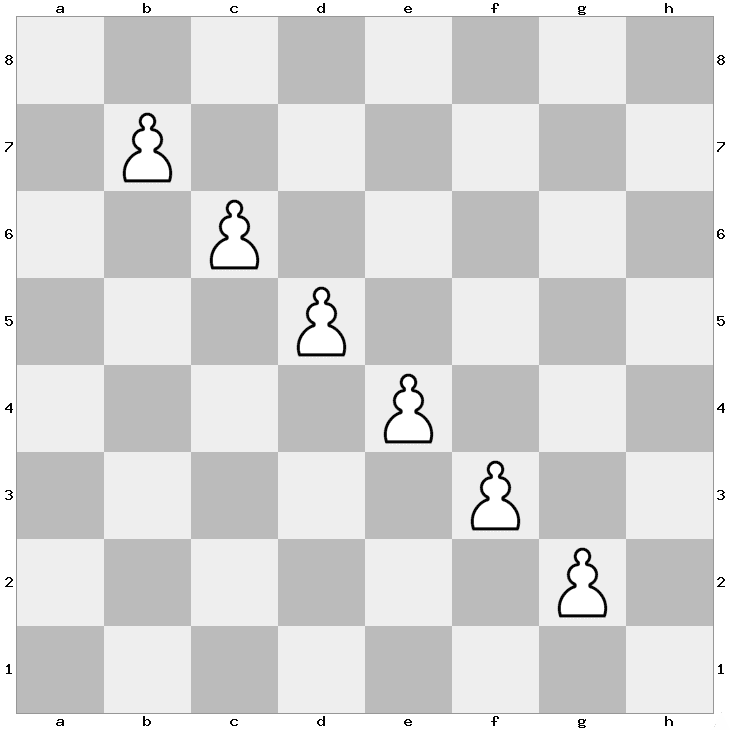
Six pawns are placed in the middle squares of the main diagonal of a chess board – b7, c6, d5, e4, f3, g2. You are allowed to take any pawn on the chessboard and replace it with two pawns – one on the square above it and one on the square on its right, in case there are empty squares there. If after several moves there are no more pawns on the main diagonal, show that all the squares above it except for h8 are covered by pawns.

Assign the following weights on the squares of the chessboard:

  • 1 on the main diagonal a8 – h1
  • 1/2 on the diagonal b8 – h2
  • 1/4 on the diagonal c8 – h3
  • 1/8 on the diagonal d8 – h4
  • 1/16 on the diagonal e8 – h5
  • 1/32 on the diagonal f8 – h6
  • 1/64 on the diagonal g8 – h7

Every time you make the splitting move, the total sum of the numbers of the squares covered by pawns remains a constant. At the beginning that sum is 6. Since 7/2 + 6/4 + 5/8 + 4/16+ 3/32 + 2/64 = 6, all 27 squares above the main diagonal, except the top-right corner (on which you can not place a pawn in any way), must be covered by pawns at the end.

Monochromatic

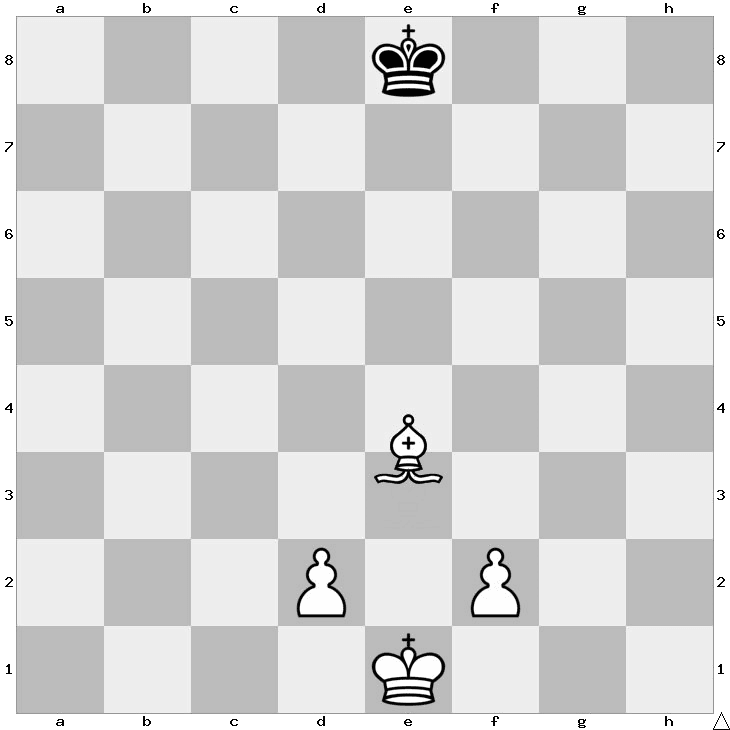
If you know that the following game has been monochromatic, i.e. no piece has moved from black to white square or vice-versa, which one is the correct position of the bishop – e3 or e4?

The correct position of the bishop is e3. Otherwise, no White’s piece could have captured the last Black’s piece, moving on black squares.