
Cork in a Glass

You have a jar filled with water and a glass. If you pour some water into the glass and place a cork in it, the cork will float towards the edges of the glass. What is the easiest way to make the cork float towards the center?

Since the liquid molecules adhere to the glass molecules on the sides of the glass, the water level there is higher and buoyancy makes the cork float in that direction. If you fill the glass all the way to the edge, then the water surface will be convex and the cork will float towards the center.

Picture from Russia

Look at the picture below and answer the following questions:

  1. What time of the day is it?
  2. Is it early spring or a late fall?
  3. Is the river navigable?
  4. Which direction does the river flow? (North, East, South or West?)
  5. Is the river deep or shallow at the side where the boat is?
  6. Is there a bridge across the river nearby?
  7. How far is the railroad from here?
  8. Do the birds fly North or South?

2. People are sowing the crops, so it is early spring.
8. Since it is spring, birds are flying North.
1. Since birds are flying North, the shadows are pointing East, and therefore it is morning.
4. Judging by the water around the buoy, the river is flowing South.
3. Since there is a buoy, the river must be navigable.
5. The fishing line is long, so the river must be deep.
6. There would not be a ferry if there was a bridge nearby.
7. The guy on the left looks like a railroad worker, so probably the railroad is nearby.

Knocked Off Piece

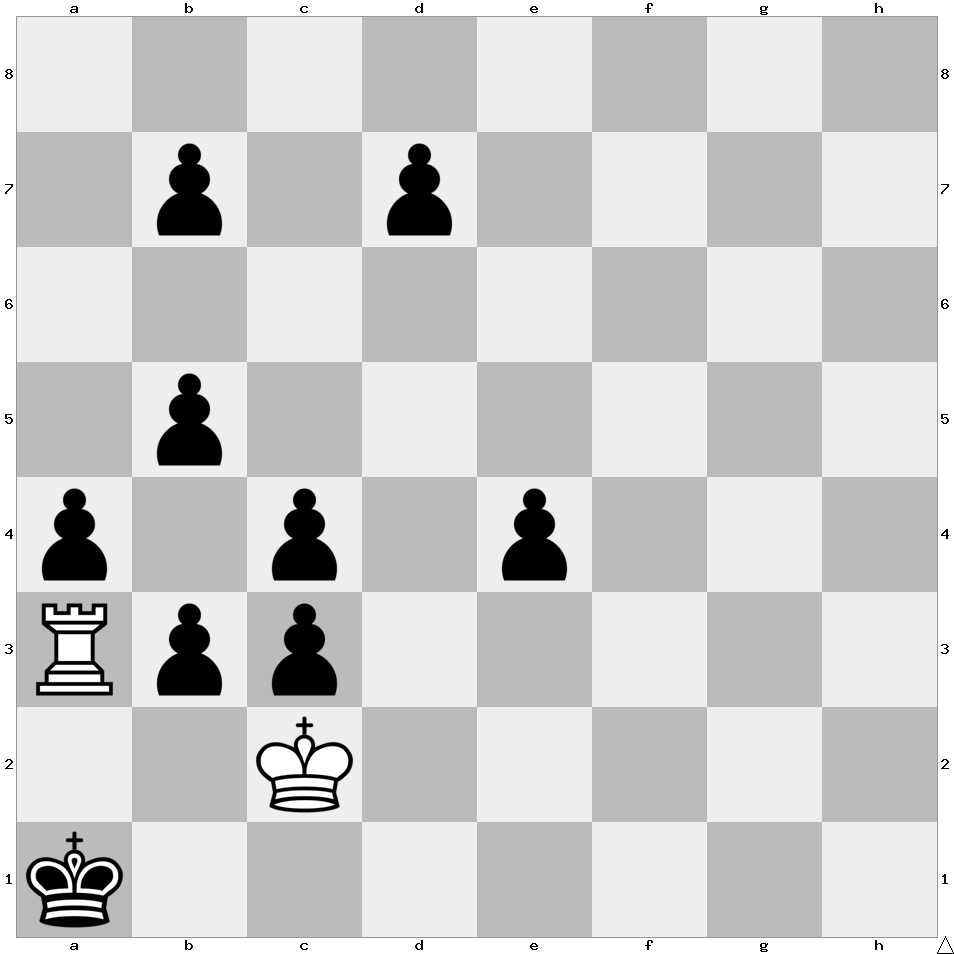
The following position occurs in a real game, right after one of the pieces gets knocked off the board. What was the piece?

It was a black knight. First, notice that the black pawns have moved 14 times diagonally and thus they have taken 14 pieces. Therefore the knocked off piece is black. Since it is impossible for both kings to be checked at the same time, the missing piece was positioned on a2. It couldn’t be a queen or a rook, because the white king would be checked both by it and the pawn on b3, which is impossible. Therefore the missing piece is either the black white-squared bishop or the black knight. However, the pawns on b7 and d7 haven’t been moved the entire game and then the black white-squared bishop hasn’t either. Thus we conclude that the knocked off piece is a black knight.

Two Games at Once

The Devil offers you a deal – you have to play two games of chess simultaneously against the two best GrandMasters in the world, one with black pieces and one with white pieces. If you win at least 1 point from the two games, you will get whatever your heart desires, if you don’t – you will go straight to Hell. Would you accept the challenge?

Accept the challenge. You can easily get 1 point by just repeating the moves of your opponents. For example, if the white GrandMaster plays e4, then you play e4 against the black GrandMaster. If the back GrandMaster plays e5, then you play e5 against the white GrandMaster and so on.

Camel in the Desert

One man is trying to cross the desert to reach the neighboring village. It takes 4 days to get there, but his camel can carry bananas which will feed him for 3 days only. How can the man reach the neighboring village without starving?

The man travels one day, leaves one portion of bananas in the desert and returns back to his village. Then he leaves again with 3 new portions of bananas, picks the portion left in the desert on his way and ends up in the neighboring village on the sixth day.

15 Puzzle

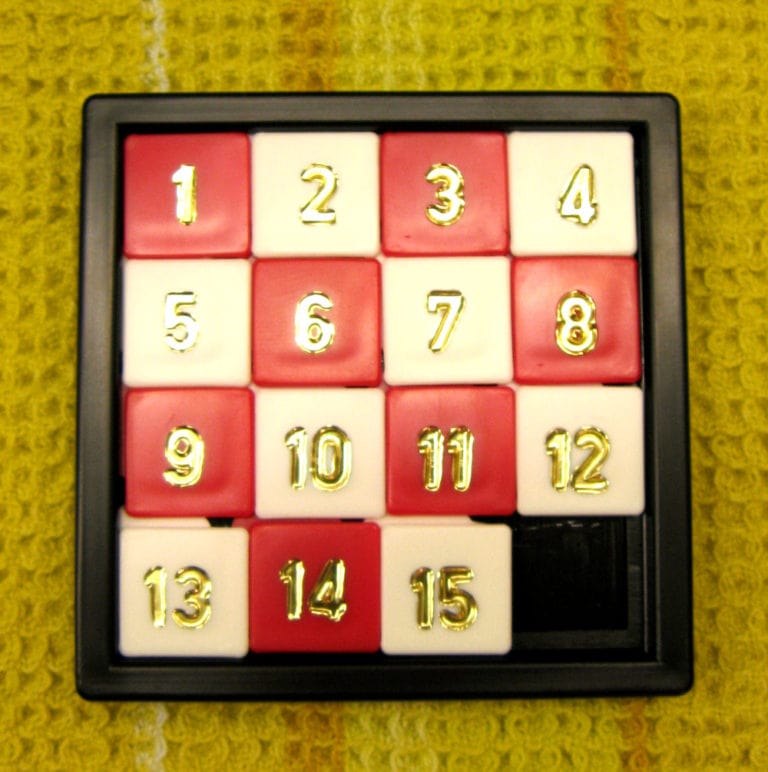
On the picture, you can see the famous “15 Puzzle”. The rules are simple – you can slide any of the 15 squares to the empty spot if it neighbors with it. The question is: if the squares with numbers 14 and 15 are exchanged, can you solve the puzzle, i.e. can you bring it to the state shown on the picture?

No, you can’t. In order to see this, at each moment count the number of pairs of little squares, which are wrongly ordered. For example, if the numbers on the first row are 7, 2, 12 and 5 in this order, then 7 and 2, 7 and 5, and 12 and 5 are wrongly ordered. Notice that after every move you make, the number of wrongly ordered pairs changes with an odd number – ± 3 or ± 1. If you want to go from the state in which squares 14 and 15 are exchanged to the solved state on the picture, you must make an even number of moves and therefore you would change the number wrongly ordered pairs by an even number. However, the number of wrongly ordered squares in the starting state is 1, whereas in the ending state is 0, which yields a contradiction.