Creepy Beasts Inc.

At Creepy Beasts Inc., three of the most dreaded animals, a tiger, a wolf, and a bear, sat in their boardroom in silence while they awaited their boss. Then, Mr. Tiger broke the silence.

“Isn’t it odd that our three surnames are the same as our three species, yet none of our surnames matches our own species?”

The wolf replied, “Yeah, but does anyone care?”

They sat in silence again…

Can you figure out the surname of each animal?

Since the wolf replied to Mr. Tiger, his surname can be neither Tiger nor Wolf. Therefore, the wolf’s surname is Mr. Bear. Subsequently, Mr. Tiger must be a bear, and finally, Mr. Wolf must be a tiger.

Odd Rectangle

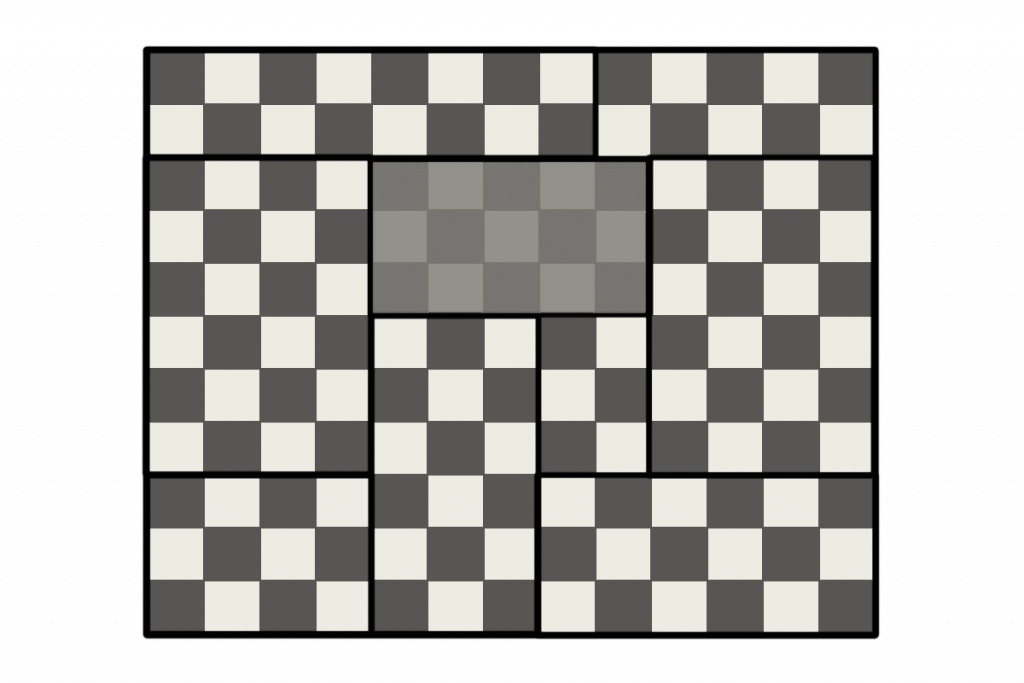
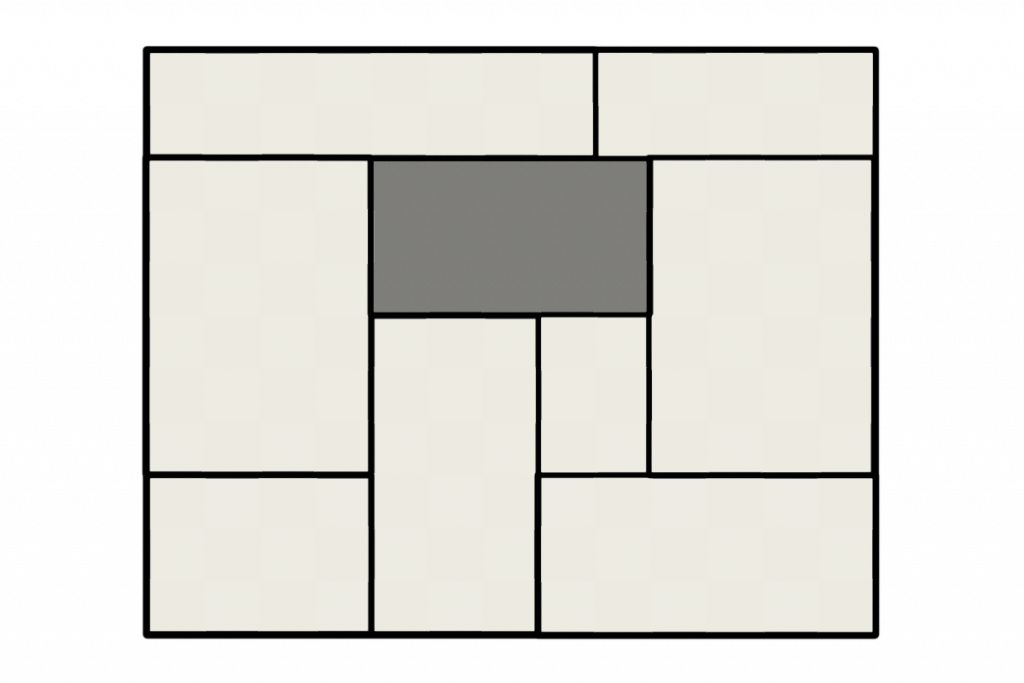
The sides of a rectangle have lengths which are odd numbers. The rectangle is split into smaller rectangles with sides which have integer lengths. Show that there is a small rectangle, such that all distances between its sides and the sides of the large rectangle have the same parity, i.e. they are all even or they are all odd.

Split the large rectangle into small 1×1 squares and color it in black and white, chessboard-style, such that the four corner squares are black. Since the large rectangle has more black squares than white squares, one of the smaller rectangles also must have more black squares than white squares. Therefore, the four corners of that smaller rectangle are all black. Then, it is easy to see that all distances between its sides and the sides of the large rectangle have the same parity.

Source:

Shortlist IMO 2017

Ten Lanterns

You have ten lanterns, five of which are working, and five of which are broken. You are allowed to choose any two lanterns and make a test that tells you whether there is a broken lantern among them or not. How many tests do you need until you find a lantern you know for sure is working?

Remark: If the test detects that there are broken lanterns, it does not tell you which ones and how many (one or two) they are.

You need 6 tests:

(1, 2) → (3, 4) → (5, 6) → (7, 8) → (7, 9) → (8, 9)

If at least one of these tests is positive, then you have found two working lanterns.

It all of these tests are negative, then lantern #10 must be working. Indeed, since at least one lantern in each of the pairs (1, 2), (3, 4), (5, 6) is not working. Therefore, there are at least 2 working lanterns among #7, #8, #9, #10. If #10 is not working, then at least one of the pairs (7, 8), (7, 9), or (8, 9) must yield a positive test, which is a contradiction.

Buffalo Buffalo Buffalo

The sentence below is grammatically correct. Can you explain it?

Buffalo buffalo Buffalo buffalo buffalo buffalo Buffalo buffalo.

The sentence says that buffalo (animals) from Buffalo (city, US), which are buffaloed (intimidated) by Buffalo (city, US) buffalo (animals), themselves buffalo (intimidate) buffalo (animals) from Buffalo (city, US).

Diagonal in a Rectangle

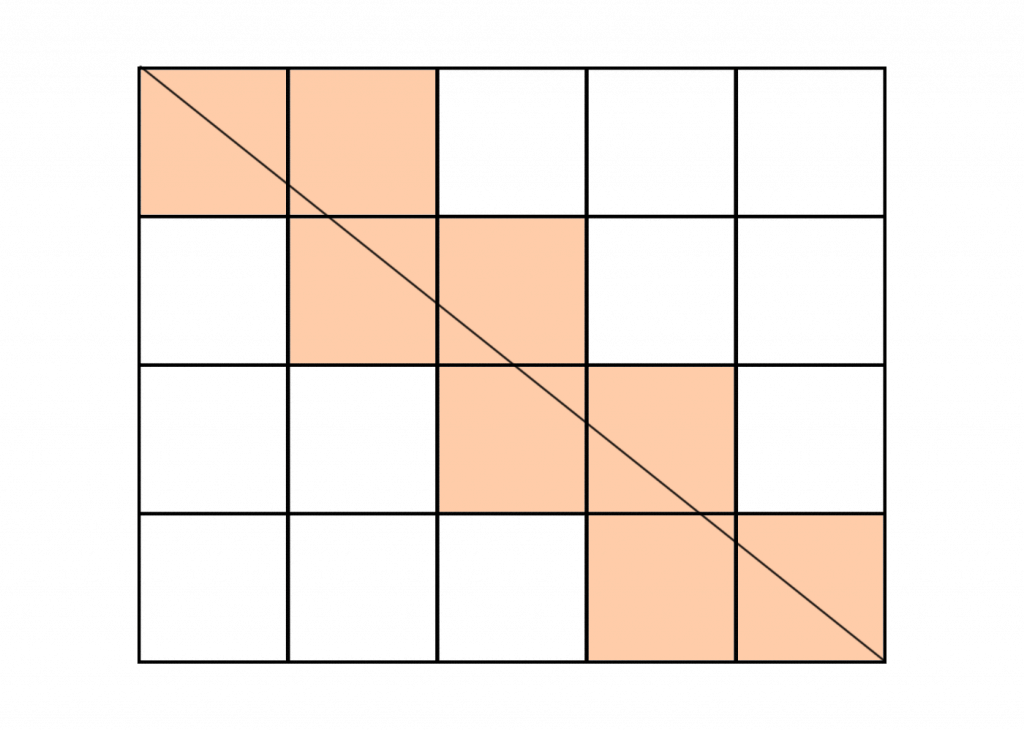
A 1000 × 1004 rectangle is split into 1 × 1 squares. How many of these squares does the main diagonal of the large rectangle pass through?

Notice that the number of small squares the main diagonal passes through is equal to the number of horizontal and vertical lines it intersects. Indeed, every time the diagonal goes through the interior of one square to the interior of another, it must intersect one of these lines.

There are 1000 + 1004 = 2004 lines which are intersected by the main diagonal. However, on four occasions (which is the greatest common divisor of 1000 and 1004), the main diagonal intersects one horizontal and one vertical line at the same time, which results in double-counting., so we must subtract 4 from the answer.

Therefore, the answer is 1000 + 1004 – 4 = 2000.

FEATURED

Rhombuses

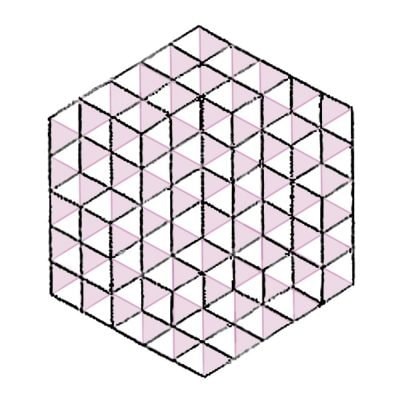
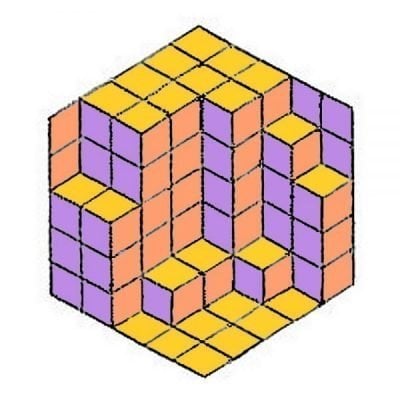
A regular hexagon is split into small equilateral triangles and then the triangles are paired arbitrarily into rhombuses. Show that this results into three types of rhombuses based on orientation, with equal number of rhombuses from each type.

Color the rhombuses based on their type and imagine the diagram represents a structure of small cubes arranged in a larger cube. If you look at the large cube from three different angles, you will see exactly the three types of rhombuses on the diagram.

Alternatively, the problem can be proven more rigorously by considering the three sets of non-intersecting broken lines connecting the pairs of opposite sides of the hexagon, as shown on the image below. The type of each rhombus is determined by the types of the broken lines passing through it. Therefore, there are n² rhombuses of each type, where n is the length of the hexagon’s sides.