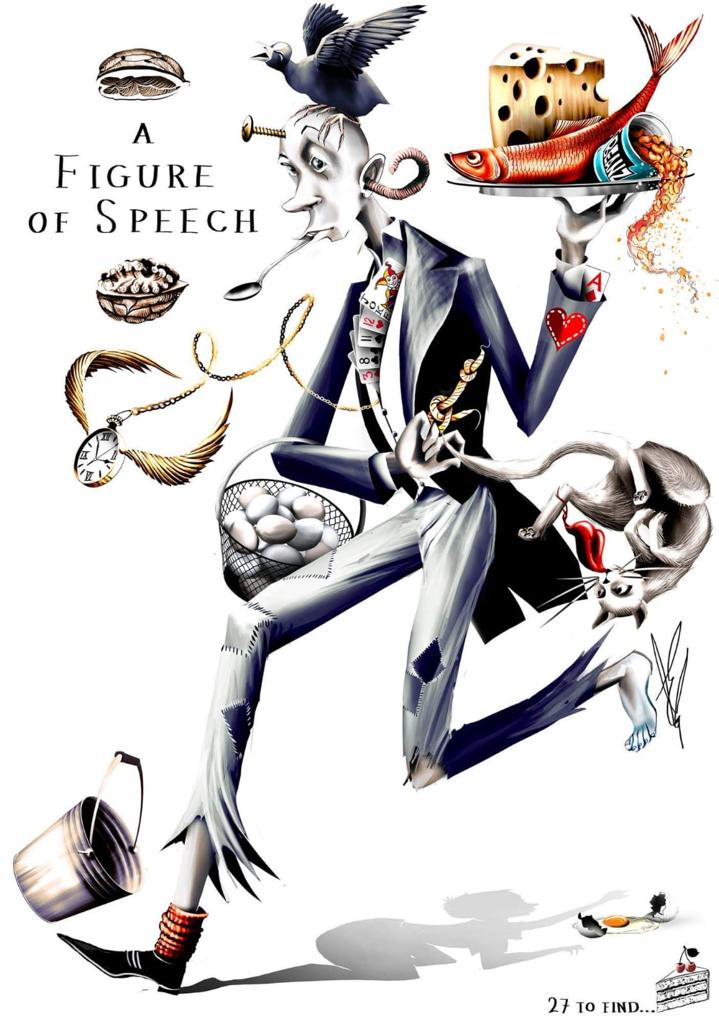
Ella Baron is an editorial cartoonist and comics artist, creating visual narratives with drawings that are dark, spiky and detailed. They tend towards social commentary and satire.
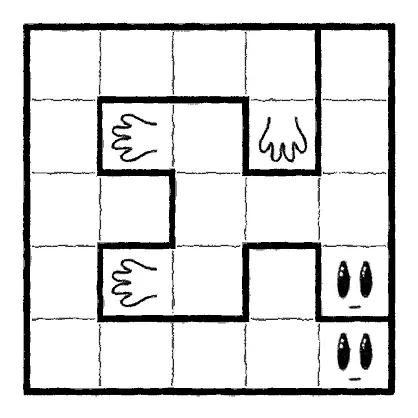
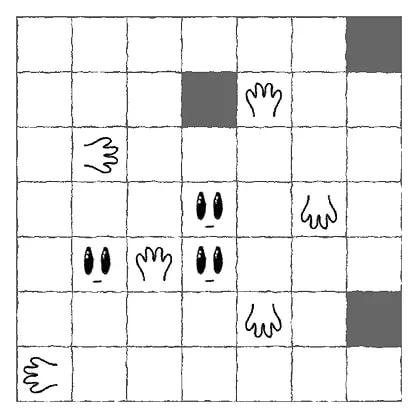
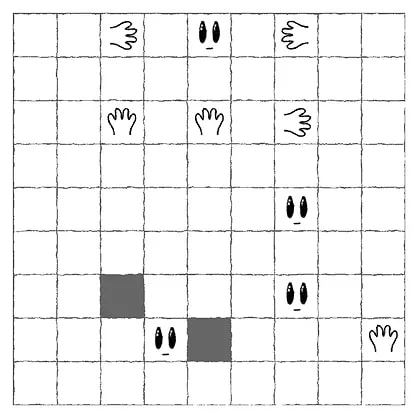
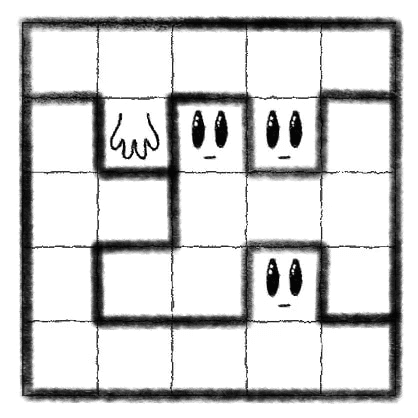
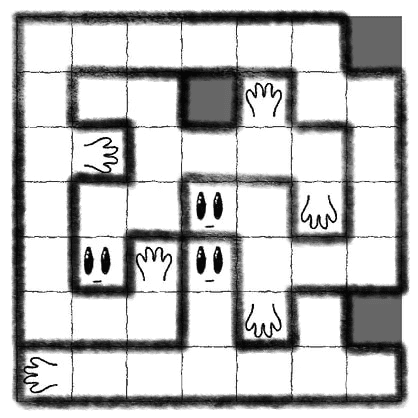
Partition the grid into disjoint “creatures”, according to the following rules:
Each creature is defined as a shape of 4 connected branches that are each 1 cell wide.
For each creature, one of the branches ends up with a HEAD (always clued) and the other three branches end up with LIMBS (whenever clued, their directions matter).
A creature can never occupy a 2×2 region of cells and can never touch itself.
Examine the first example, then solve the other three puzzles.
RABBIT sounds like the noise a FROG makes, OWL sounds like the noise a WOLF makes, BEAR sounds like the noise a SHEEP makes, and MOOSE sounds like the noise a COW makes. Since BUCK sounds like the noise a CHICKEN makes, that’s the answer.
If you make a CORRECT statement, you will get either a lollipop or a chewing gum. If you make a FALSE statement, you will get either a chocolate or a car. What statement should you make in order to get the car?
SOLUTION
You should say “I will receive a chocolate”. This statement cannot be correct, since if it was, you would get a lollipop or a chewing gum, not a chocolate. Therefore, you will get the car.
Can you find a triple of three-digit numbers that sum up to 999 and collectively contain all digits from 1 to 9 exactly once? How many such triples are there? What if the sum was 1000?
SOLUTION
There are exactly 180 such triples that sum up to 999 and none that sum up to 1000.
In order to see that, notice that the sum of the first digits of the numbers can be no more than 9. Since the sum of all digits is 45, the sum of the middle and the sum of the last digits should be both no more than 9+8+7=24, and no less than 45-9-24=12. We then see that the sum of the last digits should be exactly 19 and the sum of the middle digits should be exactly 18. The sum of the first digits should be 45-19-18=8.
There are 2 ways to get 8 using unique digits from 1 to 9: 1+2+5 and 1+3+4.
If the first digits are {1, 2, 5}, the options for the middle digits are {3, 6, 9}, {3, 7, 8}, and {4, 6, 8}. The last digits end up {4, 7, 8}, {4, 6, 9}, and {3, 7, 9} respectively.
If the first digits are {1, 3, 4}, the options for the middle digits are {2, 7, 9} and {5, 6, 7}. The last digits end up {5, 6, 8} and {2, 8, 9} respectively.
Since the set of the first digits, the set of the middle digits, and the set of the last digits of the numbers can be permuted in 6 ways each, we get a total of 5×6×6×6=1080 solutions, or 180 up to permutation of the 3 three-digit numbers.
In order to see that we cannot get a sum of 1000, we note that since the sum of the digits from 1 to 9 is divisible by 9, then the sum of the 3 three-digit numbers should be divisible by 9 as well. Since 1000 is not divisible by 9, the statement follows.