One patient has two bottles with 30 pills each and every night has to take one pill from each of the bottles. Unfortunately one night after he takes out a pill from the first bottle and places it on the table, by accident drops two pills from the second bottle right next to it. The pills look identical, so he can not differentiate them. It is very important that he continues his treatment diligently throughout the entire timespan of 30 days. What should the patient do?
SOLUTION
The patient should keep taking one pill from each bottle until there are 4 pills remaining – 1 in the first bottle and 3 on the table. On the 29th day he splits the pills in halves and takes one half from each pill. On the 30th day he takes the remaining halves of the pills.
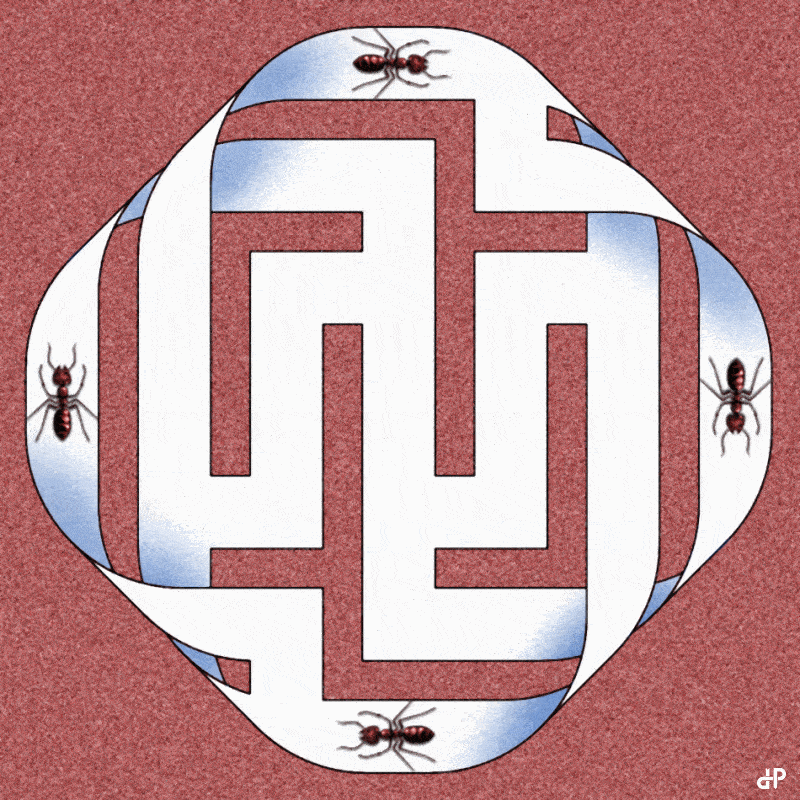
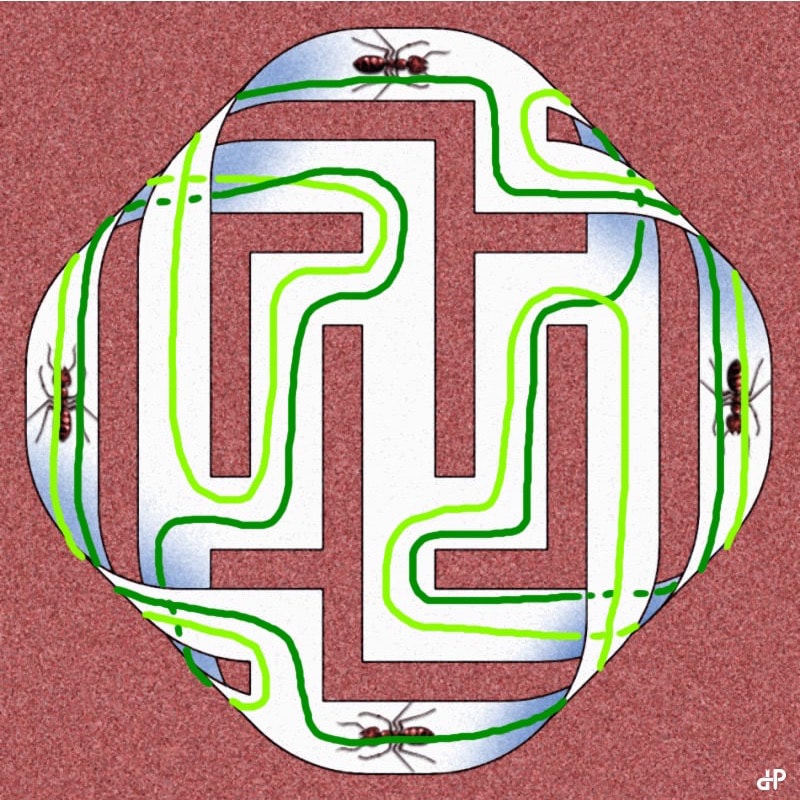
Find a non-intersecting closed path, passing through all four ants, which traverses this double-sided maze. You can not switch between the top and the bottom side of the path at any times.
There are 100 inmates living in solitary cells in a prison. In a room inside the prison there are 100 boxes and in each box there is a paper with some prisoner’s name (all different). One day the warden tells the prisoners that he has aligned next to the wall in a special room 100 closed boxes, each of them containing some prisoner’s name (all different). He will let every prisoner go to the room, open 50 of the boxes, then close them and leave the room the way it was, without communicating with anybody. If all prisoners find their names in the boxes they open, they will be set free, otherwise they will be executed. The prisoners are allowed to come up with a quick plan before the challenge begins. Can you find a strategy which will ensure a success rate of more than 30%?
SOLUTION
The prisoners can assign numbers to their names – 1, 2, 3, … , 100. When prisoner X enters the room, he should open first the X-th box in the line. If he sees inside prisoner’s Y name, he should open next the Y-th box in the line. If he sees in it prisoner’s Z name, he should open next the Z-th box in the line and so on.
The only way which will prevent all prisoners from finding their names is if there is a long cycle of boxes (length 51 or more), such that the first box in the cycle directs to the second box in it, the second box to the third box, the third box to the fourth box and so on.
It is not hard to compute that the probability of having a cycle of length K>50 is exactly 1/K. Then the probability for failure will be equal to the sum 1/51 + 1/52 + … + 1/100, which is very close to ln(100) – ln(50) = ln(2) ~ 69%. Therefore, this strategy ensures a success rate of more than 30%.
Mick, Nick, and Rick arrange a three-person gun duel. Mick hits his target 1 out of every 3 times, Nick hits his target 2 out of every 3 times, and Rick hits his target every time. If the three are taking turns shooting at each other, with Mick starting first and Nick second, what should be Mick’s strategy?
SOLUTION
Clearly, Mick should not aim for Nick, because if he kills him, then he will be killed by Rick. Similarly, Nick should not aim for Mick, because if he kills him, then he also will be killed by Rick. Therefore, if Rick ends up against alive Mick and Nick, he will aim at Nick, because he would prefer to face off a weaker opponent afterward. This means that if Nick is alive after Mick shoots, he will shoot at Rick.
Thus, if Mick shoots at Rick and kills him, then he will have to face off Nick with chance of survival less than 1/3. Instead, if he decides to shoot in the air, then he will face off Nick or Rick with chance of survival at least 1/3. Therefore, Mick’s strategy is to keep shooting in the air, until he ends up alone against one of his opponents.
You have four metal chains and each of them has three links. What is the minimal number of cuts you need to make so that you can connect the chains into one loop with twelve links?
SOLUTION
You need only three cuts – cut all the links of one of the chains and then use them to connect the ends of the remaining three chains.