
Vectors -1, 0, 1

Consider all 1024 vectors in a 10-dimensional space with elements ±1. Show that if you change some of the elements of some of the vectors to 0, you can still choose a few vectors, such that their sum is equal to the 0-vector.

Denote the 1024 vectors with ui and their transformations with f(ui). Create a graph with 1024 nodes, labeled with ui. Then, for every node ui, create a directed edge from ui to ui-2f(ui). This is a valid construction, since the vector ui-2f(ui) has elements -1, 0, and 1 only. In the resulting graph, there is a cycle:

v1 ⇾ v2 ⇾ … ⇾ vk ⇾ v1.

Now, if we pick the (transformed) vectors from this cycle, their sum is the 0-vector:

f(v1) + f(v2) + … + f(vk) = (v2 – v1)/2 + (v3 – v2)/2 + … + (v1 – vk)/2 = 0.

Thoka’s Rebus 2

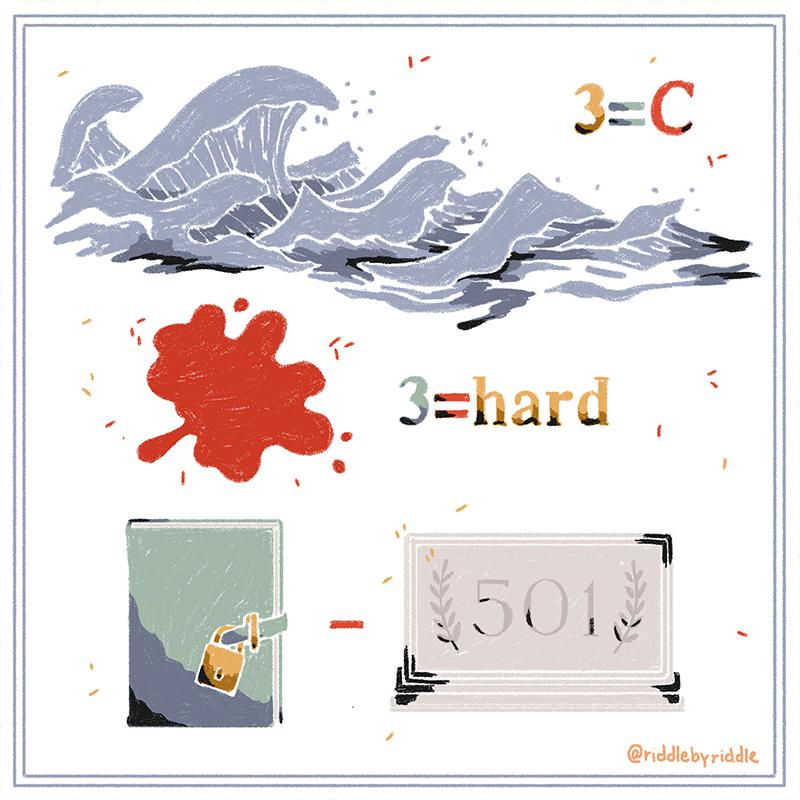
Can you figure out which word is depicted by this rebus?

The first image depicts a SEA. When you switch the third letter to C, you get SEC. The second image depicts RED. When you make the third letter a hard consonant, you get RET. The last two images depict a DIARY and DI (501 in Roman numerals). Therefore, you get:

SEC + RET + DIARY – DI = SECRETARY

Creepy Beasts Inc.

At Creepy Beasts Inc., three of the most dreaded animals, a tiger, a wolf, and a bear, sat in their boardroom in silence while they awaited their boss. Then, Mr. Tiger broke the silence.

“Isn’t it odd that our three surnames are the same as our three species, yet none of our surnames matches our own species?”

The wolf replied, “Yeah, but does anyone care?”

They sat in silence again…

Can you figure out the surname of each animal?

Since the wolf replied to Mr. Tiger, his surname can be neither Tiger nor Wolf. Therefore, the wolf’s surname is Mr. Bear. Subsequently, Mr. Tiger must be a bear, and finally, Mr. Wolf must be a tiger.

Odd Rectangle

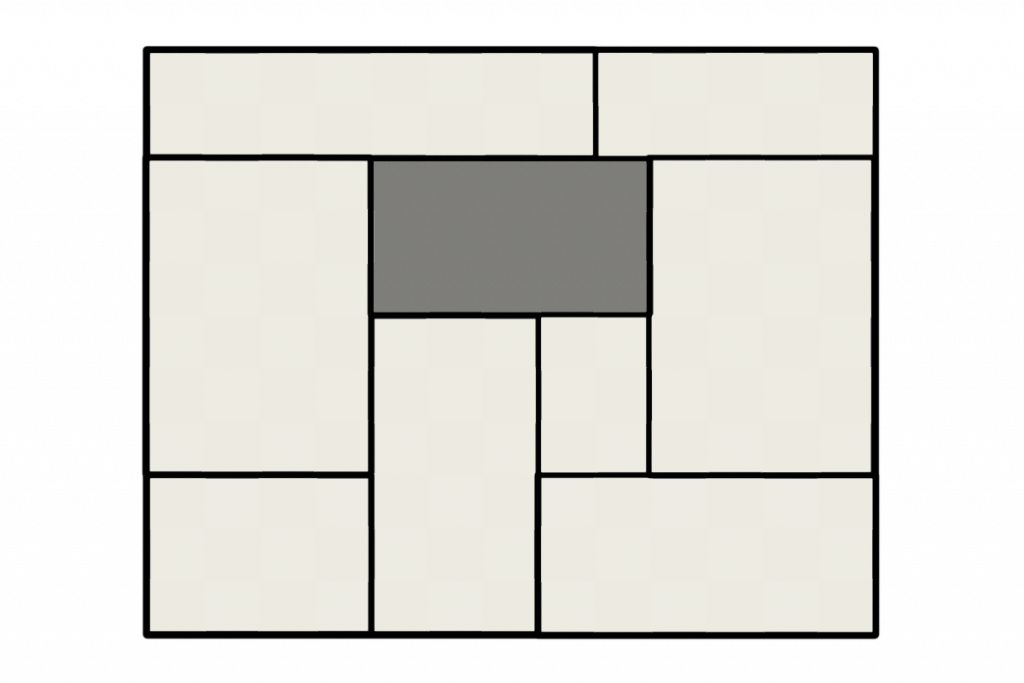
The sides of a rectangle have lengths which are odd numbers. The rectangle is split into smaller rectangles with sides which have integer lengths. Show that there is a small rectangle, such that all distances between its sides and the sides of the large rectangle have the same parity, i.e. they are all even or they are all odd.

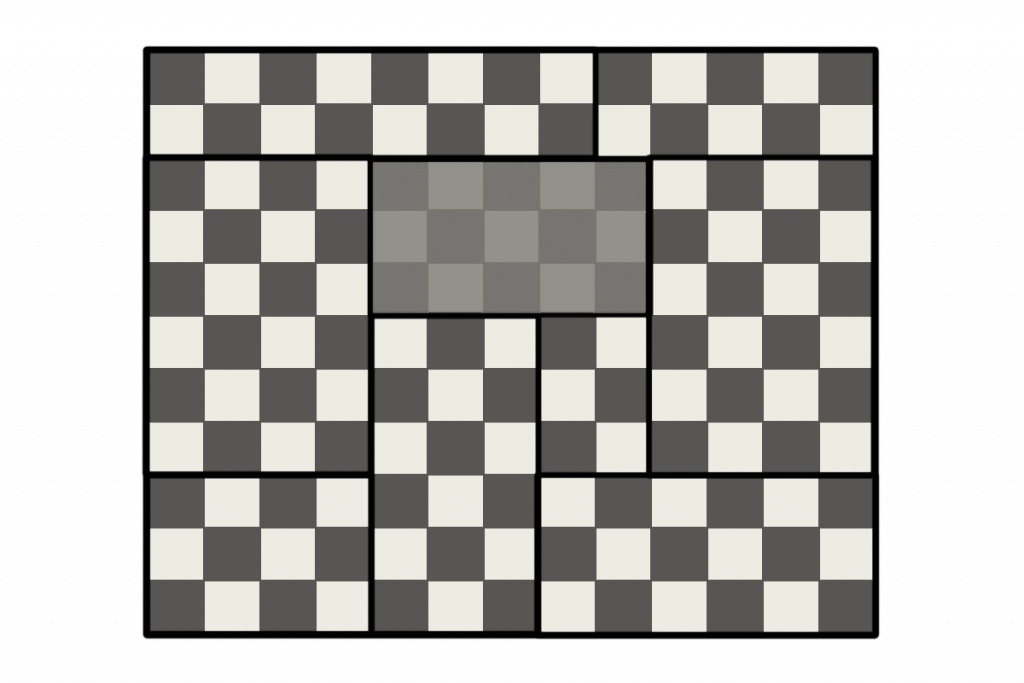
Split the large rectangle into small 1×1 squares and color it in black and white, chessboard-style, such that the four corner squares are black. Since the large rectangle has more black squares than white squares, one of the smaller rectangles also must have more black squares than white squares. Therefore, the four corners of that smaller rectangle are all black. Then, it is easy to see that all distances between its sides and the sides of the large rectangle have the same parity.

Source:

Shortlist IMO 2017

Ten Lanterns

You have ten lanterns, five of which are working, and five of which are broken. You are allowed to choose any two lanterns and make a test that tells you whether there is a broken lantern among them or not. How many tests do you need until you find a lantern you know for sure is working?

Remark: If the test detects that there are broken lanterns, it does not tell you which ones and how many (one or two) they are.

You need 6 tests:

(1, 2) → (3, 4) → (5, 6) → (7, 8) → (7, 9) → (8, 9)

If at least one of these tests is positive, then you have found two working lanterns.

It all of these tests are negative, then lantern #10 must be working. Indeed, since at least one lantern in each of the pairs (1, 2), (3, 4), (5, 6) is not working. Therefore, there are at least 2 working lanterns among #7, #8, #9, #10. If #10 is not working, then at least one of the pairs (7, 8), (7, 9), or (8, 9) must yield a positive test, which is a contradiction.

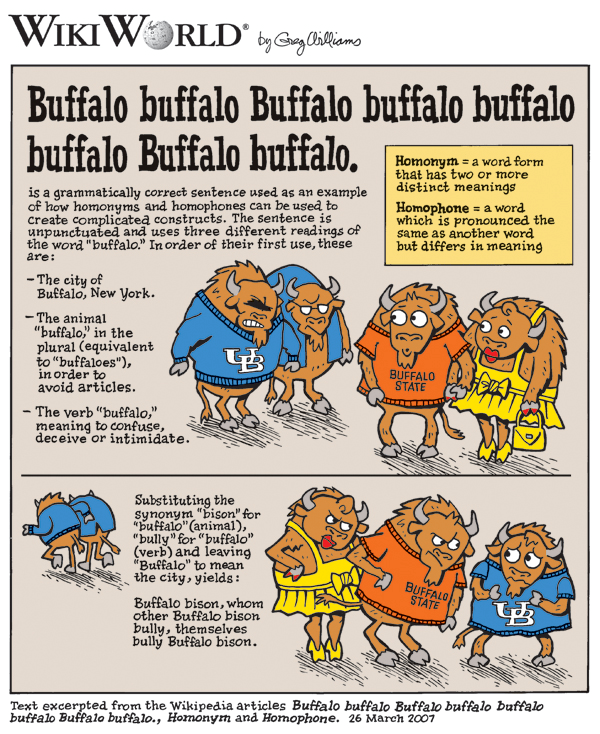
Buffalo Buffalo Buffalo

The sentence below is grammatically correct. Can you explain it?

Buffalo buffalo Buffalo buffalo buffalo buffalo Buffalo buffalo.

The sentence says that buffalo (animals) from Buffalo (city, US), which are buffaloed (intimidated) by Buffalo (city, US) buffalo (animals), themselves buffalo (intimidate) buffalo (animals) from Buffalo (city, US).