
An Ant’s Path

An ant is positioned at one of the vertices of a cube and wants to get to the opposite vertex. If the edges of the die have length 1, what is the shortest distance the ant needs to travel?

We unfold a cube to get a cross-shaped figure. Then, the problem is to find the shortest path between two points separated by a horizontal distance of 2 units and a vertical distance of 1 unit.
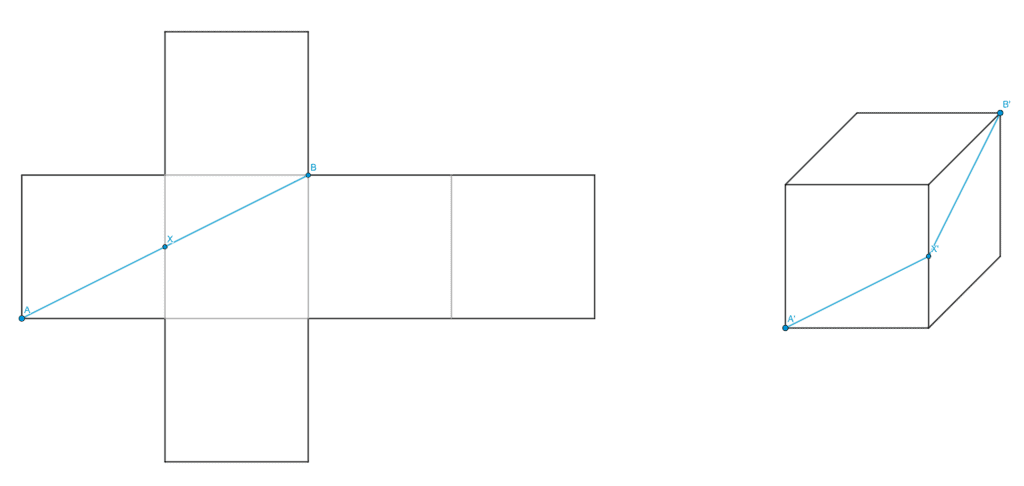
It is easy to see that the path in question is the one passing through the middle of the edge between the start and end points, and which has a distance of √5.

A Square and an Invisible Point

There is a square drawn on a piece of paper and also a point marked with invisible ink. You are allowed to draw 3 lines on the paper and for each of them you will be told whether the point is on its left, on its right, or lies on the line. Your task is to find out whether the point is inside the square, outside the square, or on its boundary. How do you do it?

Draw one of the diagonals of the square. Then, draw the 2 lines containing the sides of the square that are on the same side as the invisible point.

Touch or Don’t Touch

For this puzzle/game, you need to keep presenting various words to your friends and telling them whether they are “TOUCH” or they are “DON’T TOUCH”. Below, we have listed several words from each category.

TOUCH: banana, proof, mouse, keyboard, promo, woman

DON’T TOUCH: cherry, solution, cat, screen, discount, girl


Can you guess what determines whether a word is “TOUCH” or “DON’T TOUCH”?

Words that make your lips touch when pronounced belong to the “TOUCH” category, while the others belong to the “DON’T TOUCH” category. The sounds “P”, “B”, “M”, and “W” that cause this are called “bilabial”.

Five Points, Ten Distances

Five points, A, B, C, D, and E, lie on a line. The distances between them in ascending order are: 2, 5, 6, 8, 9, X, 15, 17, 20, and 22. What is X?

We assume that the points are ordered A to E from left to right. We have AE = 22 and either AD = 20, BE = 17, or AD = 17, BE = 20. Without loss of generality AD = 20, BE = 17, and therefore AB = 5, BD = 15, DE = 2. The distance of 6 is associated with either BC or CD, and therefore the points are arranged in one of these two ways:

  1. AB = 5, BC = 6, CD = 9, DE = 2
  2. AB = 5, BC = 9, CD = 6, DE = 2

If it is the latter, we get the sequence of distances: 2, 5, 6, 9, 11, 14, 15, 17, 20, 22, which does not fit the provided sequence.

If it is the former, we get the sequence of distances: 2, 5, 6, 8, 9, 14, 15, 17, 20, 22, and therefore X = 14.