At 12 PM a scientist put a bacteria in a container. The bacteria reproduce by splitting every minute into two. If at exactly 1 PM the container was full, at what time was it half-full?
SOLUTION
Since every minute the bacteria double their quantity, the container was half-full at 12:59 PM.
Five pirates steal a treasure which contains 100 gold coins. The rules for splitting the treasure among the pirates are the following:
The oldest pirate proposes how to split the money.
Everybody votes, including the proposer.
If there are more than 50% negative votes, the proposer gets thrown in the water and the procedure repeats.
Given that the pirates are very smart and bloodthirsty (if they can kill another without losing money, they will do it), how should the oldest pirate suggest to split the money among the five of the in order to maximize his profit?
SOLUTION
Solve the problem backward. Let the pirates be called A, B, C, D, E, where A is older than B, B is older than C, C is older than D and D is older than E. If there are only two pirates left – D and E, then the D will keep all the treasure for himself. If there are three pirates left – C, D, and E, C can propose to give just 1 coin to E and keep the rest for himself. Pirate E will agree because otherwise, he will get nothing. If there are four pirates left – B, C, D, and E, then B can propose to give just 1 coin to D and keep the rest for himself. Pirate D will agree because otherwise, he will get nothing. Now if there are five pirates – A, B, C, D and E, A should give coins to at least two other pirates, because otherwise at least three of them will vote negative. Clearly, B will always vote negative, unless he gets offered 100 coins and D will also vote negative, unless he gets 2 coins or more. Pirate A can offer to give one 1 coin to C, 1 coin to E and keep the rest for himself and this is the only optimal proposal – 98:0:1:0:1.
Two friends made a bet whose horse is slower. After wondering for days what is the fastest and fairest way to figure out who wins the bet, they finally decided to ask a famous wise hermit for help. Upon giving them his advice, the two friends jumped on the horses and started racing back to the city as fast as they could. What did the hermit say?
SOLUTION
He told them to switch their horses and whoever gets to the city first will win the bet.
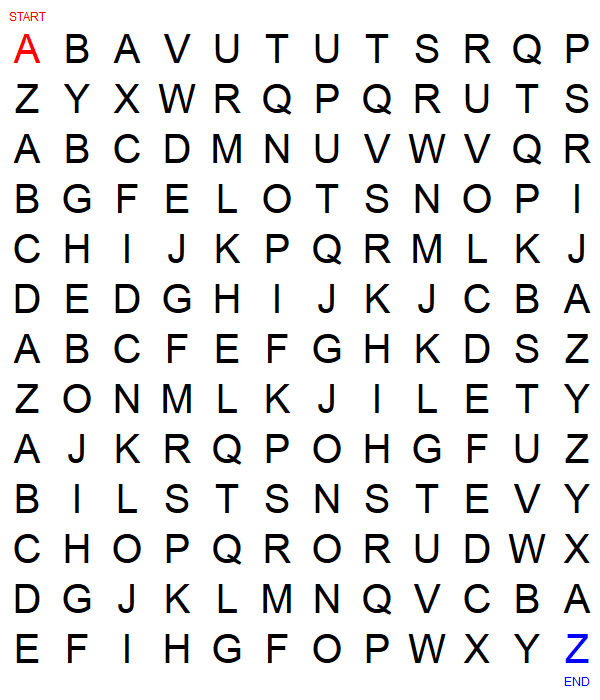
Here’s a little maze puzzle I originally built a couple of years ago, that seems apropos to reprise now:
Can you make it from the A in the top left of this grid to the Z in the bottom right, always going either up one letter (for instance, A to B or G to H) or down one letter (for instance, N to M)? The alphabet wraps around, so you can go from Z up to A or A down to Z too. Try as hard as you can (and remember that you can always work backward if you get stuck forwards), and see where you get!
Remark: Solving the maze is not the same thing as solving the puzzle. Read those instructions carefully!
SOLUTION
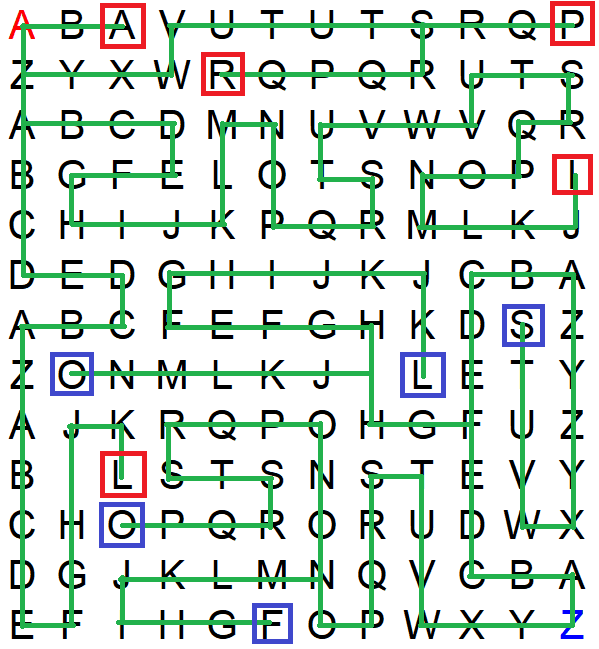
Notice this puzzle is published on April 1st. Actually, it doesn’t have a standard solution. If you connect every two consecutive letters which appear next to each other in the grid, you will get two disconnected components, one of which contains the START and the other contains the END. The first component has 5 dead-ends – at letters A, P, R, I, L, and the second component has 5 dead-ends – at letters F, O, O, L, S. These two spell out “April Fools”, which is the real solution of the maze.
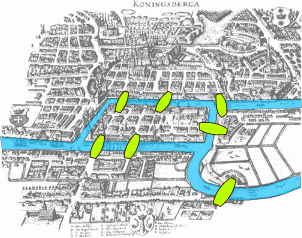
This is a map of old-time Kongsberg. The green shapes are bridges which connect the different parts of the city. Can you find a path through the city which goes through every bridge exactly once?
SOLUTION
No, you cannot. Notice that, except for the first city and the last city section you finish, the number of bridges used in every other section is even. However, there are three sections with an odd number of bridges, and therefore you cannot use all bridges exactly once.