Blaž Urban Gracar is a Slovenian artist. He is a musician (composing music for the theater, producing left-field electronica, playing keyboards in a rock band), writer (publishing poetry, prose, and comic books), filmmaker (editing and animating short films), and game designer (mostly creating puzzly solo games).
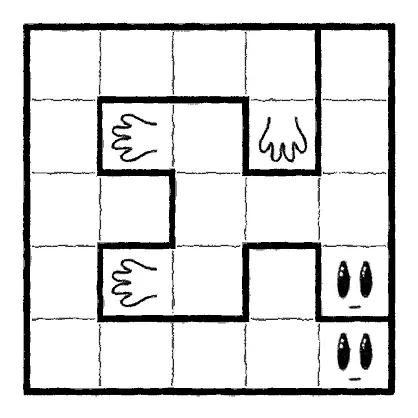
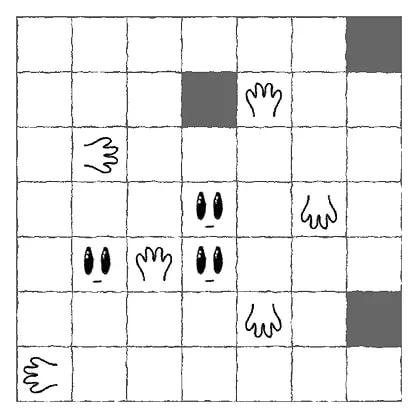
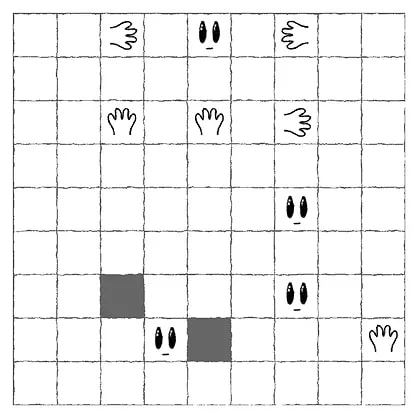
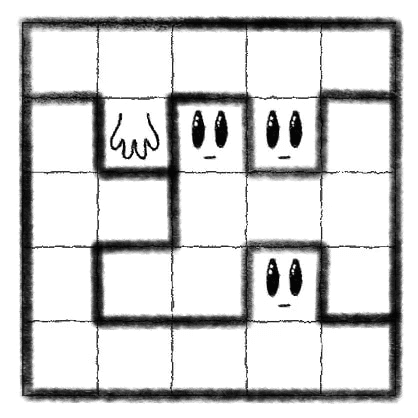
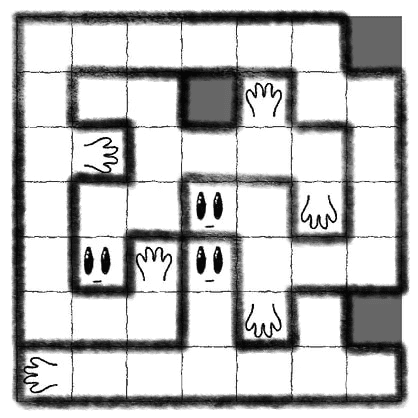
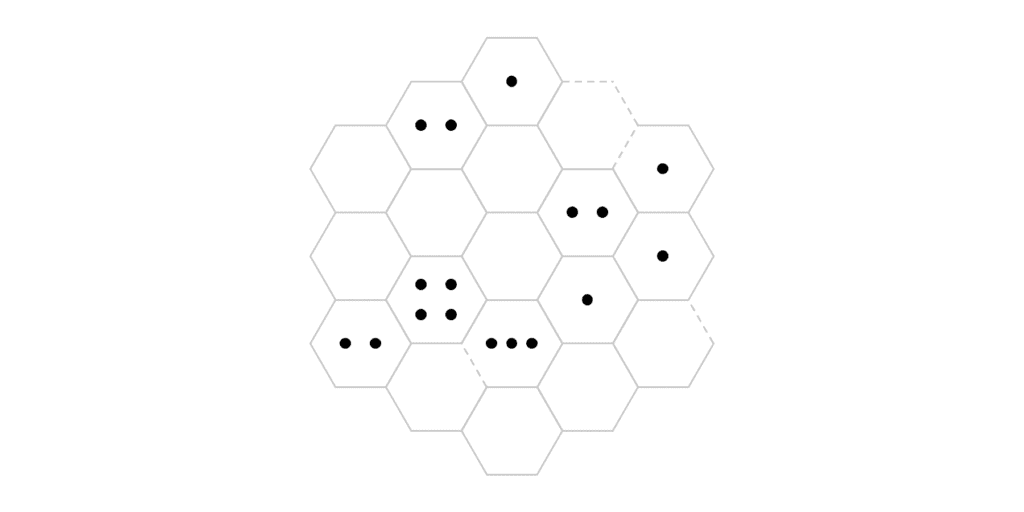
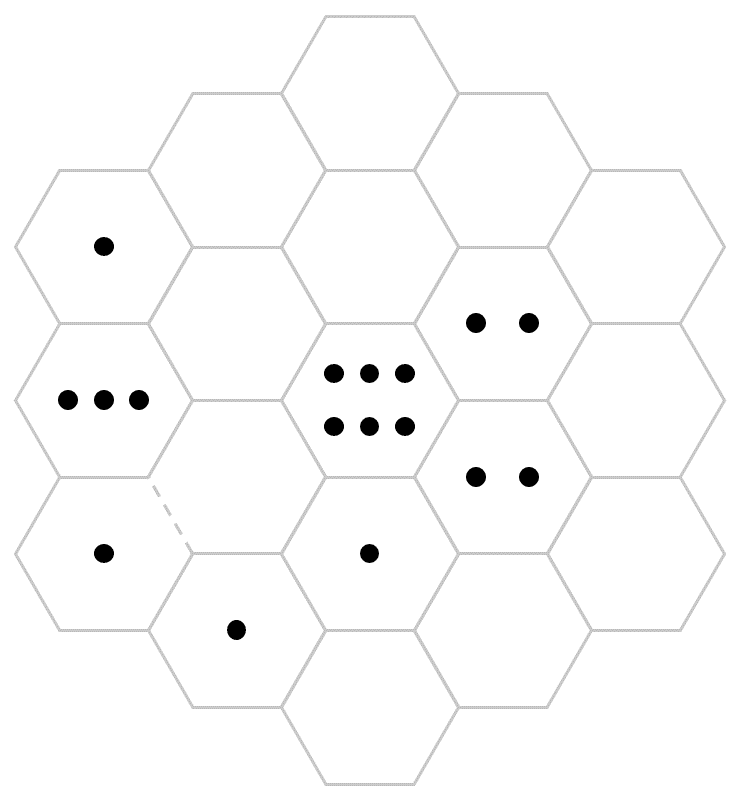
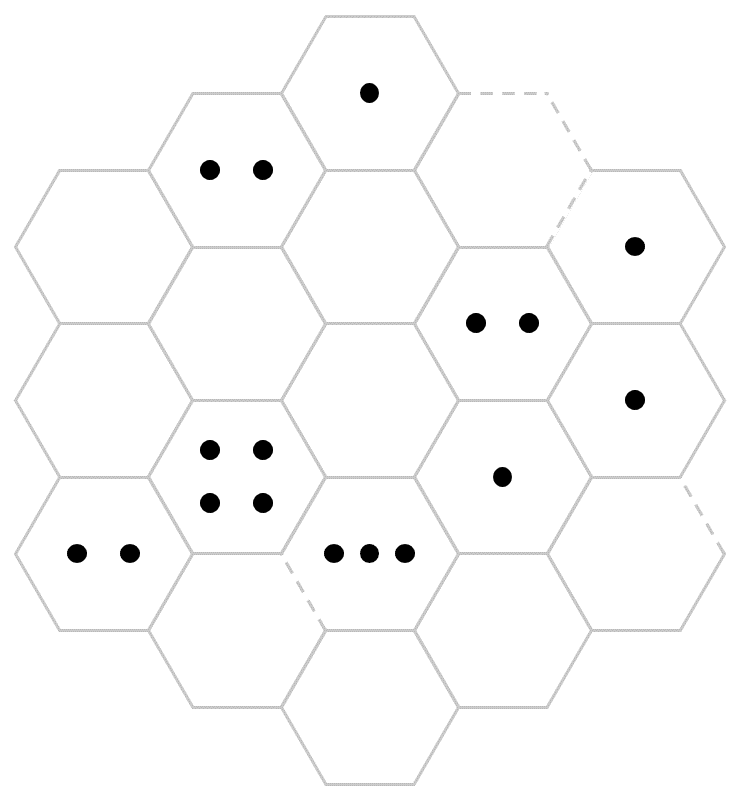
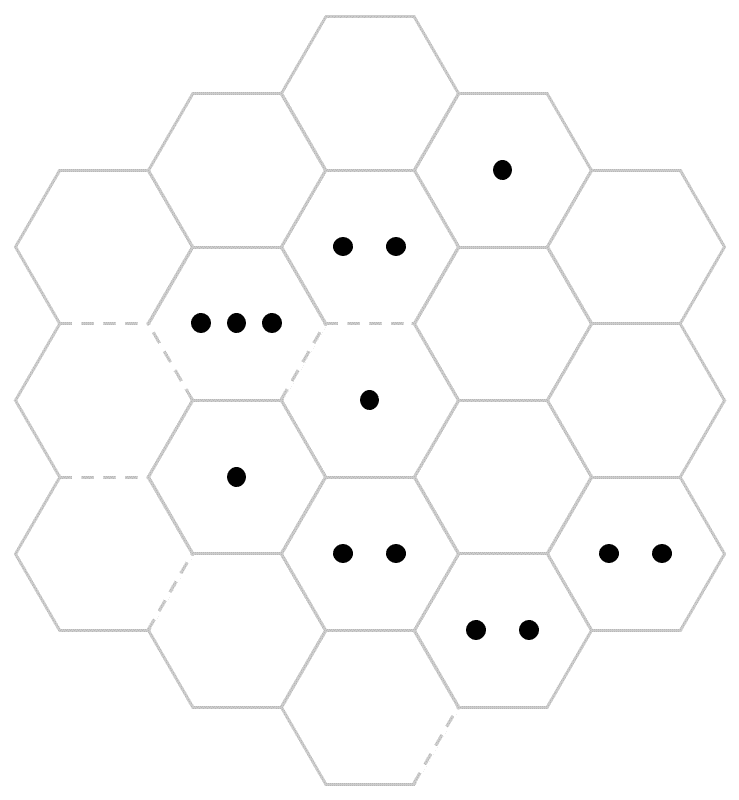
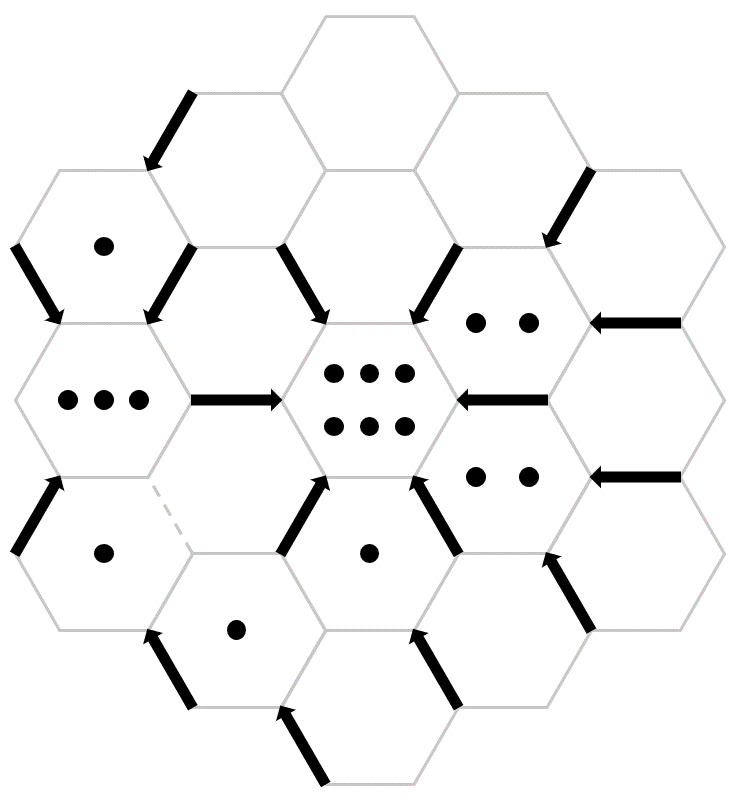
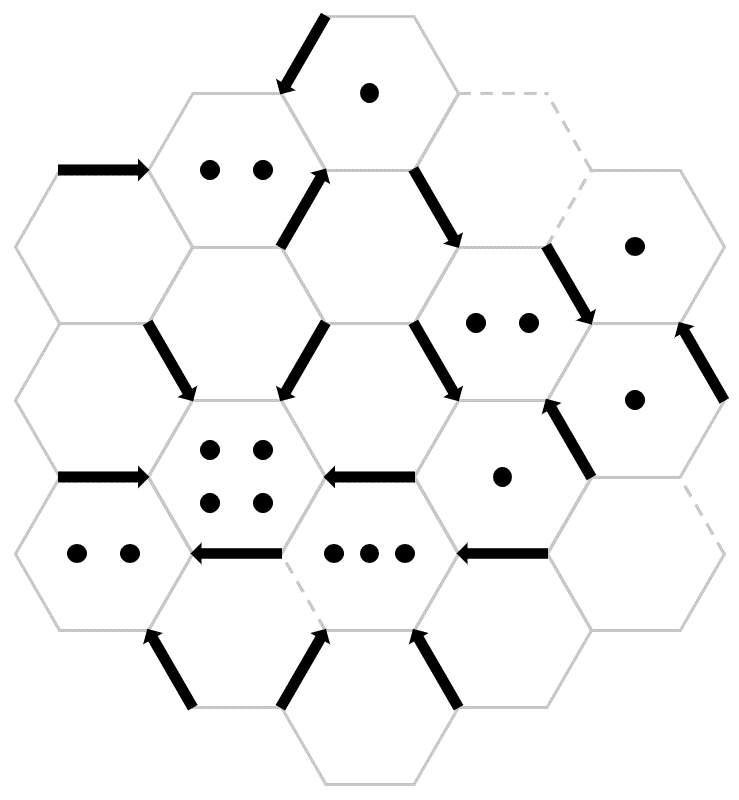
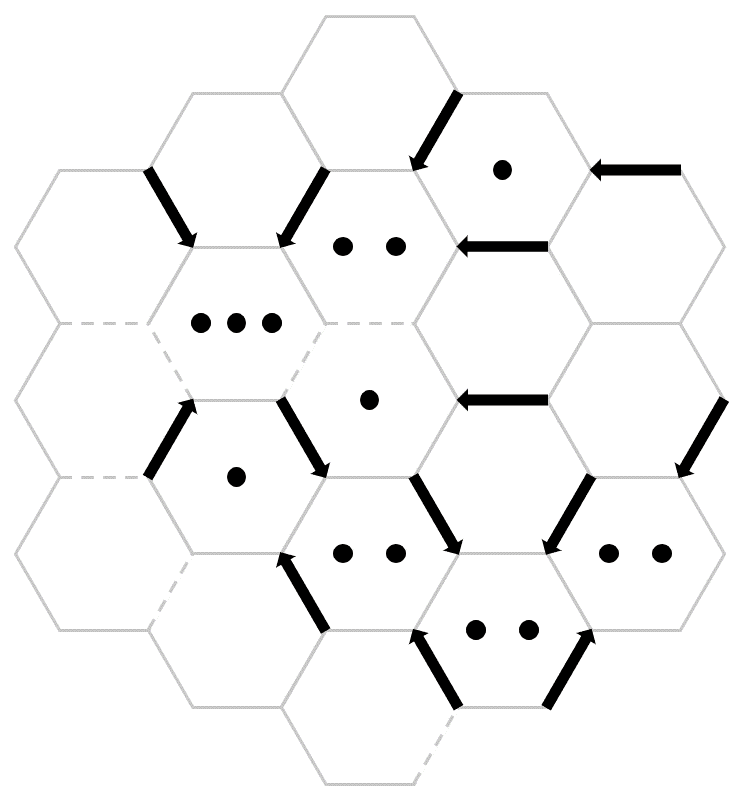
Partition the grid into disjoint “creatures”, according to the following rules:
Each creature is defined as a shape of 4 connected branches that are each 1 cell wide.
For each creature, one of the branches ends up with a HEAD (always clued) and the other three branches end up with LIMBS (whenever clued, their directions matter).
A creature can never occupy a 2×2 region of cells and can never touch itself.
Examine the first example, then solve the other three puzzles.
Can you find a triple of three-digit numbers that sum up to 999 and collectively contain all digits from 1 to 9 exactly once? How many such triples are there? What if the sum was 1000?
SOLUTION
There are exactly 180 such triples that sum up to 999 and none that sum up to 1000.
In order to see that, notice that the sum of the first digits of the numbers can be no more than 9. Since the sum of all digits is 45, the sum of the middle and the sum of the last digits should be both no more than 9+8+7=24, and no less than 45-9-24=12. We then see that the sum of the last digits should be exactly 19 and the sum of the middle digits should be exactly 18. The sum of the first digits should be 45-19-18=8.
There are 2 ways to get 8 using unique digits from 1 to 9: 1+2+5 and 1+3+4.
If the first digits are {1, 2, 5}, the options for the middle digits are {3, 6, 9}, {3, 7, 8}, and {4, 6, 8}. The last digits end up {4, 7, 8}, {4, 6, 9}, and {3, 7, 9} respectively.
If the first digits are {1, 3, 4}, the options for the middle digits are {2, 7, 9} and {5, 6, 7}. The last digits end up {5, 6, 8} and {2, 8, 9} respectively.
Since the set of the first digits, the set of the middle digits, and the set of the last digits of the numbers can be permuted in 6 ways each, we get a total of 5×6×6×6=1080 solutions, or 180 up to permutation of the 3 three-digit numbers.
In order to see that we cannot get a sum of 1000, we note that since the sum of the digits from 1 to 9 is divisible by 9, then the sum of the 3 three-digit numbers should be divisible by 9 as well. Since 1000 is not divisible by 9, the statement follows.
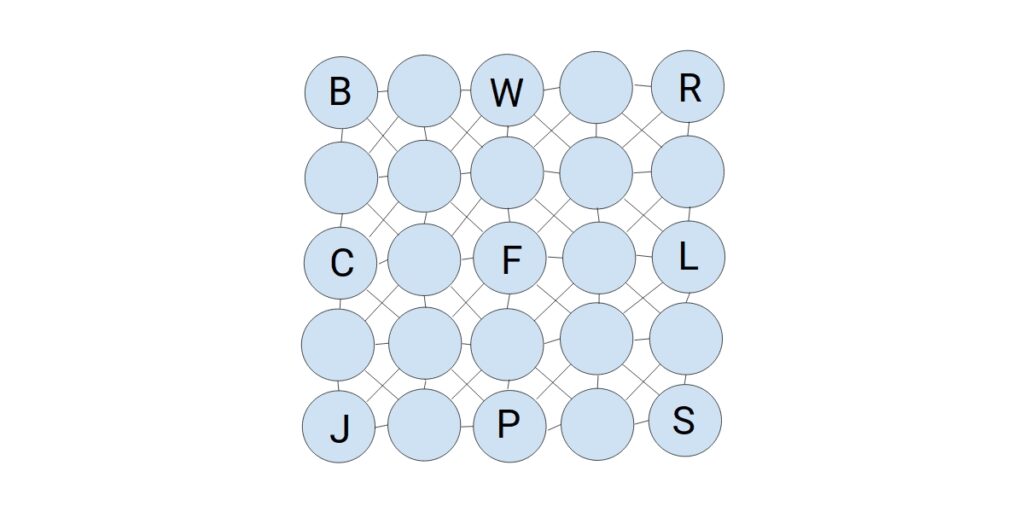
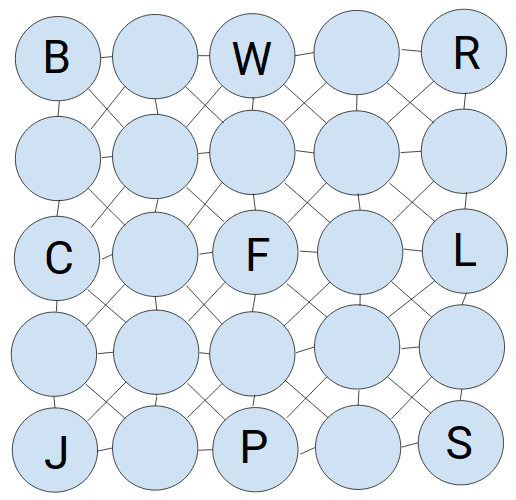
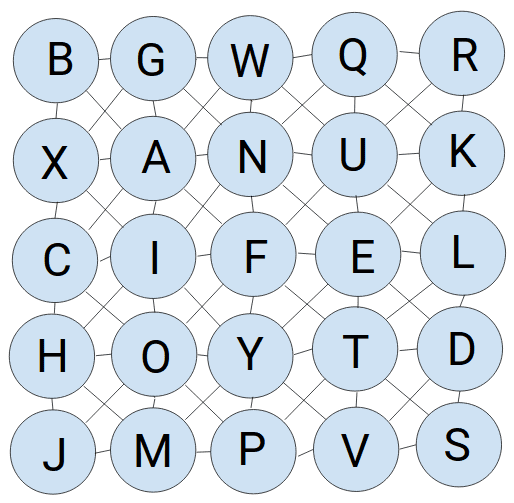
Add the 25 letters between A and Y to the grid below. Each one should appear exactly once. When you have finished, you must be able to spell the following words moving horizontally, vertically or diagonally around the grid:
For this puzzle/game, you will need to find a group of friends, preferably 5 or more. The premise is that you will go together on a vacation but each of you can bring only specific items there. The rules regarding which items can be brought and which not are known by one of the players and the other ones are trying to guess them.
In the exchange below, George is the one organizing the trip and the one who knows which items the rest are allowed to bring.
GEORGE: I will take my guitar with me. What do you want to take?
SAM: Can I take an umbrella with me?
GEORGE: No, you cannot take an umbrella, but you can take some sunscreen.
HELLEN: Can I take a scarf with me?
GEORGE: No, you cannot take a scarf, but you can take a hat.
MONICA: Can I take a dress with me?
GEORGE: No, you cannot take a dress, but you can take some makeup.
Can you guess what the rules of the game are?
SOLUTION
Everyone is allowed to take with themselves only items whose first letter is the same as the first letter of their names. Thus, George can take a Guitar, Sam can take Sunscreen, Hellen can take a Hat, and Monica can take Makeup.
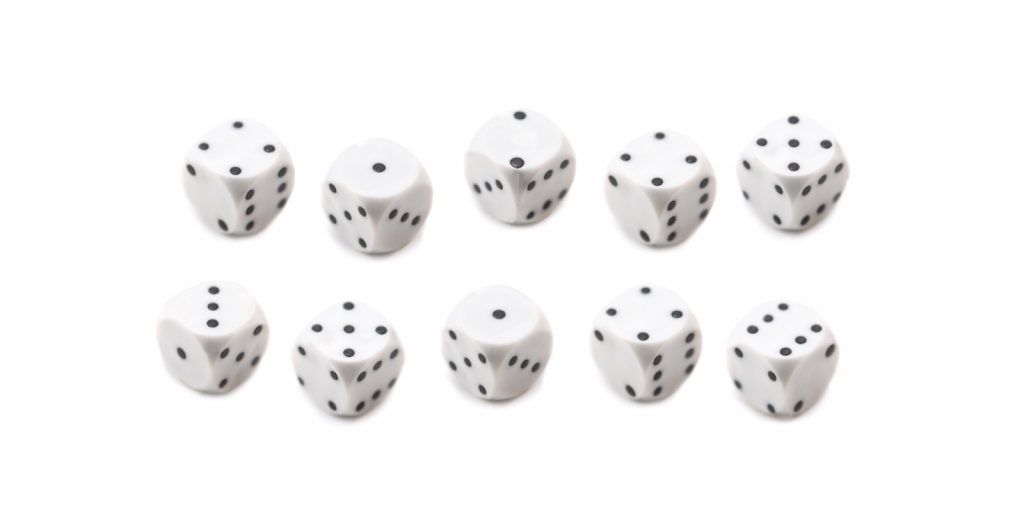
You pick a number between 1 and 6 and keep throwing a die until you get it. Does it matter which number you pick for maximizing the total sum of the numbers in the resulting sequence?
In the example below, the picked number is 6 and the total sum of the numbers in the resulting sequence is 35.
SOLUTION
No matter what number you pick, the expected value of each throw is the average of the numbers from 1 to 6 which is 3.5. The choice of the number also does not affect the odds for the number of throws until the game ends, which is 6. Therefore, the total sum is always 3.5 × 6 = 21 on average, regardless of the chosen number.
Place arrows along the hexagon edges so that the number of arrows pointing to each hexagon equals the number of dots inside, adhering to the following rules:
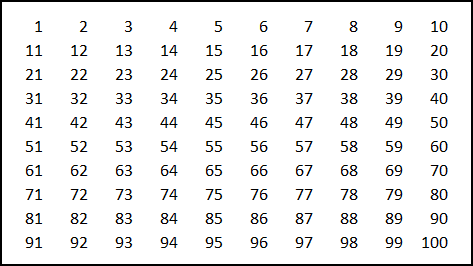
The numbers 1, 2, … , 100 are arranged in a 10×10 table in increasing order, row by row and column by column, as shown below. The signs of 50 of these numbers are flipped, such that each row and each column have exactly 5 positive and 5 negative numbers. Prove that the sum of all numbers in the resulting table is equal to 0.
SOLUTION
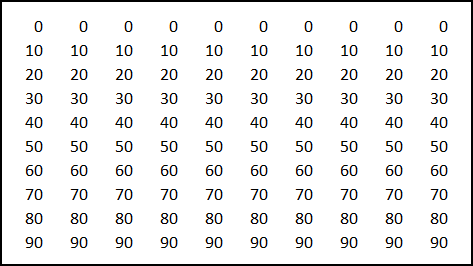
Represent the initial table as the sum of the following two tables:
Since the sum of the numbers in each row of the first table is equal to 0 and the sum of the numbers in each column of the second table is equal to 0, it follows that the sum of all numbers in both tables is equal to 0 as well.
A student was given math homework consisting of the following three problems. What is so special about this homework?
What would the value of 190 in hexadecimal be?
Twenty-nine is a prime example of what kind of number?
At time t = 0, water begins pouring into an empty tank so that the volume of water is changing at a rate V’(t)=sec²(t). For time t = k, where 0 < k < π/2, determine the amount of water in the tank.
SOLUTION
The answer to each of the problems in the homework is hidden within the question itself:
What would the value of 190 in hexadecimal be? The answer is be.
Twenty-nine is a prime example of what kind of number? The answer is prime.
At time t = 0, water begins pouring into an empty tank so that the volume of water is changing at a rate V’(t)=sec²(t). For time t = k, where 0 < k < π / 2, determine the amount of water in the tank. The answer is tank.
Who have more sisters on average in a society: boys, girls, or is it equal?
Remark: Assume that each child is born a boy or a girl with equal probability, independent of its siblings.
SOLUTION
The average number of sisters is roughly the same for both boys and girls. To see this, notice that every girl in every family contributes “one sister” to each of its siblings who are either a boy or a girl with equal probability. Therefore, every girl contributes on average the same number of sisters to the group of boys and to the group of girls. Since there is roughly the same number of boys and girls in the society, the average number of sisters for boys and girls is the same.