A princess is living in a palace which has 17 bedrooms, arranged in a line. There is a door between every two neighboring bedrooms and also a hallway which connects them all. Every night the princess moves through the inner doors from one bedroom to another. Every morning for 30 consecutive days you are allowed to go to the hallway and knock on one of the 17 doors. If the princess is inside, you will marry her. What would your strategy be?
SOLUTION
You knock on doors: 2, 3,…, 15, 16, 16, 15,…, 3, 2. This adds up to a total of 30 days exactly. If during the first 15 days you don’t find the princess, this means that every time you were knocking on an even door, she was in an odd room, and vice versa. Now it is easy to see that in the next 15 days you can’t miss her.
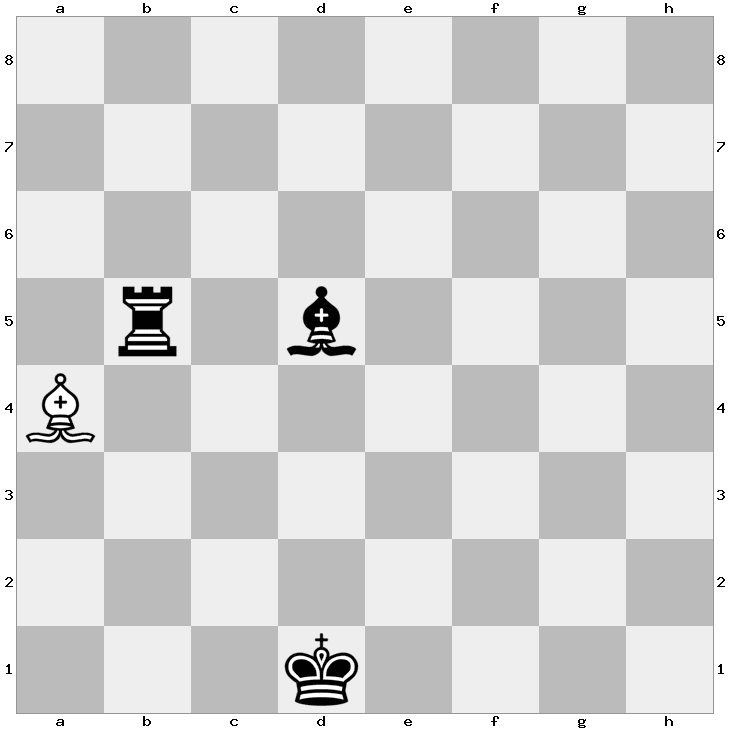
The white king has made himself invisible. Where is he?
SOLUTION
The white king is on c3. Since he cannot be currently on b3 (he will be in double check from the black rook and the black bishop), Black must be currently in check from the white bishop. That’s possible only if White has given a discovered check with his king. That’s possible only if on the previous move, the white king was on b3 and was in double check. The only possible way for this to happen is if Black gave two discovered checks at the same time. The one way to do this is if a black pawn on b4 captured a white pawn on c3 using en passant. Thus after b4xc3, the white king has just captured the black pawn on c3, and that is where he is currently hiding.
A prince decides to get married to the prettiest girl in his kingdom. All 100 available ladies go to the palace and show themselves to the prince one by one. He can either decide to marry the girl in front of him or ask her to leave forever and call the next one in line. Can you find a strategy which will give the prince a chance of 25% to get married to the prettiest girl? Can you find the best strategy?
Remark: Assume that the prince can objectively compare every two girls he has seen.
SOLUTION
A strategy which ensures a chance of 25% is the following: The prince banishes the first 50 girls which enter the palace and then gets married to the first one which is prettier than all of them (if such one arrives). If the prettiest girl in the kingdom is in the second 50, and the second prettiest girl is in the first 50, he will succeed. The chance for this is exactly 25%.
The best strategy is to wait until ~1/e of all girls pass, and then choose the first one which is more beautiful than all of them. This yields a chance of ~37% for succeeding. The proof is coming soon.
Two monks are standing on the two sides of a 2-dimensional mountain, at altitude 0. The mountain can have any number of ups and downs, but never drops under altitude 0. Prove that the monks can climb or descend the mountain at the same time on both sides, always staying at the same altitude, until they meet at the same point.
There are a fly and three spiders on the edges of a cube. If the spiders’ velocities are at least 1/3 of the fly’s velocity, and all insects can travel only along the edges of the cube, show that the spiders can eventually catch the fly.
SOLUTION
Choose two opposite edges of the cube, then let two of the spiders “protect” them from the fly. You can do this by keeping the distance from the two spiders to the edges’ endpoints at most 1/3 of the distance from the fly to these endpoints. The remaining parts of the cube do not contain any loops, so the third spider can easily catch the fly there.
A large rectangle is partitioned into smaller rectangles, each of which has integer length or integer width. Prove that the large rectangle also has integer length or integer width.
SOLUTION
This problem can be solved using graph theory, but the most elegant solution is based on some basic calculus.
Place the big rectangle in the plane so that its sides are parallel to the X and Y axes. Now integrate the function f(x)=sin(πx)sin(πy) over the boundary of any small rectangle. Since at least one of its sides has integer length, the result will be 0. If you sum all integrals taken over the boundaries of the small rectangles and cancel the opposite terms, you will get that the integral of f(x) over the boundary of the large rectangle is also equal to 0. Therefore at least one of its sides has integer length.
It is well known how to split fairly a cake between two people – one of them cuts, the other one picks. The question is, how can you split fairly a cake between three people?
Easy: “Fairly” means that every person gets at least 1/3 of the cake.
Hard: “Fairly” means that every person has the opportunity to get at least as much cakeas any other.
SOLUTION
Easy (Banach-Knaster method):
The first person cuts 1/3 piece of the cake. If the second person thinks it is larger than 1/3, he can trim it to 1/3. If the third person thinks the cut (and possibly trimmed) piece is larger than 1/3, he can trim it to 1/3 and keep it. Otherwise, the second person takes the piece if he decided to trim it, or the first one, in case he did not. After that, there are two people left, and they can easily split the remaining cake between them. This approach works for any number of people.
Hard (Selfridge-Conway method):
The first person cuts the cake in 3 pieces. The second one takes the biggest piece and trims it so that it becomes as large as the second biggest piece, puts the trimmings aside. The third person picks one of the three big pieces. Then, if the trimmed piece is still available, the second person takes it, if not – he picks whichever he likes. The first person takes the last remaining big piece. Among the first two people, whoever did not pick the trimmed big piece, splits the trimmings into 3 parts. The other one picks one of these parts, then the first person picks another. The last part goes to the person who split the trimmings.