
Around the World

There is an island on a planet and infinitely many planes on it. You need to make one of these planes fly all around the world and land back to the island. However, each of the planes can carry fuel which is enough to travel just half of the way, and fuel cannot be stored anywhere on the planet, except for the island and in the planes. Assuming the planes can refuel each other mid-air, and all of them must eventually arrive safely back on the island, how many of them do you need to accomplish the task?

3 planes are enough, label them A, B, C. They leave the island simultaneously in a clockwise direction, and after 1/8 of the way, A refuels B and C completely, then turns back towards the island. B and C continue to fly until they get to 1/4 of the way, where B refuels C completely and turns back towards the island. When C gets mid-way, A and B leave the island counter-clockwise, and after 1/8 of the way, A refuels B completely and turns back towards the island. B continues towards C, and when the two planes meet, they share their fuel, then fly together towards the island. In the meantime A arrives on the island, refuels completely, and starts flying again counter-clockwise towards B and C, so that it can meet them and give them enough fuel, so that all of them arrive safely on the island.
It is easy to see that 2 planes are not enough.


Chaos and Order

What is the secret in the pattern of this stained glass?

The image is a superposition of a blue shape and a yellow shape. The places where they coincide are colored in green (blue + yellow = green). The blue shape is consisting of horizontal stripes with lengths 3, 1, 4, 1, 5, 9, 2, 6, 5, representing the number pi, and the yellow shape is consisting of vertical stripes with lengths 4, 6, 6, 9, 2, 0, 1, 6, 1, representing the Feigenbaum constant.

Source:

Puzzling StackExchange

The Pirates and the Monkey

There are five pirates, one monkey, and lots of coconuts on an island. The pirates are supposed to share the coconuts on the next day, but while everybody is sleeping, the first pirate gives 1 coconut to the monkey, splits the remaining coconuts into 5 equal piles, and secretly keeps one of the piles for himself. Later, the second pirate does the same, then the third one, the fourth one, and the fifth one. On the morning, the pirates wake up and split all the remaining coconuts in five, leaving one last coconut for the monkey.
What is a possible number for the number of coconuts on the island?

Notice that if we find a certain number of coconuts which works, then we can add 56 and get a new one. Now imagine the pirates start with -4 coconuts, i.e. they have a total loan of 4 coconuts. Every time a pirate wakes up, he gives 1 coconut to the monkey, which makes the total loan 5 coconuts. Then the pirate keeps a loan of 1 coconut for himself and leaves -4 coconuts. Now we just add 56 coconuts to -4 to make the number positive and get 56 – 4 coconuts as a possible answer.

Two Solid Cubes of Lead

You have two solid cubes of lead, which have almost the same size. You cut a hole in one of them and pass the other one through it. After measuring the cubes later, it turns out that the larger cube is still heavier than the smaller one. How is this possible?

You cut a hole in the SMALLER cube, and pass the larger cube through it. “Prince Rupert’s cube” is the largest cube which can pass through a unit cube, and it is approximately 6% larger.

Islands and Bridges

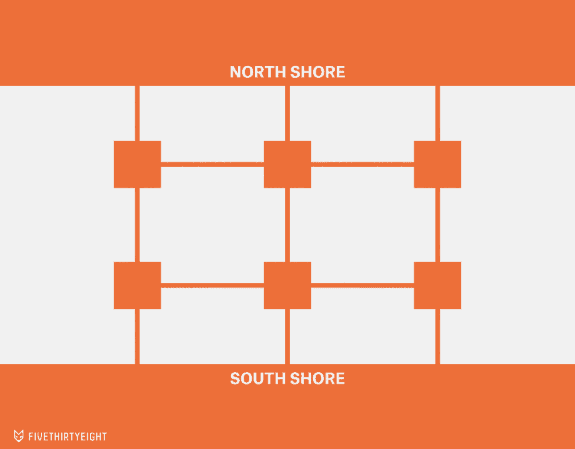
You need to cross a river, from the north shore to the south shore, via a series of 13 bridges and six islands, which you can see in the diagram below. However, as you approach the water, a hurricane passes and destroys some (possibly none/all) of the bridges. If the probability that each bridge gets destroyed is 50%, independently of the others, what is the chance that you will be able to cross the river after all?

Imagine there is a captain on a ship, who wants to sail through the river from West to East. You can see that he will be able to do this if and only if you are not able to cross the river. However, if you rotate the diagram by 90 degrees, you can also see that the probability that you cross North-South is equal to the probability that he sails West-East, and therefore both probabilities are equal to 50%.

Height Arrangement

Suppose you have 10 people with different heights in one row. Show that you can always remove 6 of them, so that the remaining 4 are arranged with respect to their heights (either increasing or decreasing).

Mark the first person with number 1. Look for the next person after him, who is taller, and also mark him with number 1. Then look for the first person after the second one, who is taller, and also mark him with number 1. If you find a fourth one, then you already got the four people you are looking for.

If not, mark the first unmarked person with number 2. Look for the next unmarked person after him, who is taller, and also mark him with number 2. Continue with the procedure, until you either find 4 people in the line, whose heights are increasing, or have people who are marked with numbers 1, 2, 3 and 4.

Now pick a person, who is marked with number 4. Then look for the closest person on the left, who is marked with number 3, pick him up. He will be taller, because otherwise the first person would have been labeled 3 as well. Similarly, look for the closest person, marked with 2, on the left of the last one, pick him up. Repeat this once again and you will find 4 people in the line, whose heights are decreasing.

Detective Flanders and the Zodiac Killer

1ntroduction

Detective Flanders and the Zodiac Killer is a Puzzle Crime 5tory, exclusively created for Puzzle Prime. Every chapter you read contains a puzzle that must be solved in order to continue further. Sometimes it may not be instantly clear what the puzzle is, but there will be clues spread over the text to guide you. 0nce you figure it out, you will reveal a four-digit passcode which will be your key to the next chapter.

Can you unravel the captivating story of Detective Flanders and the 2odiac Killer? Input your first passcode below and press “Continue” to find out.

Walkthrough Guide

If you struggle with the puzzles, feel free to use our Walkthrough Guide and request help.