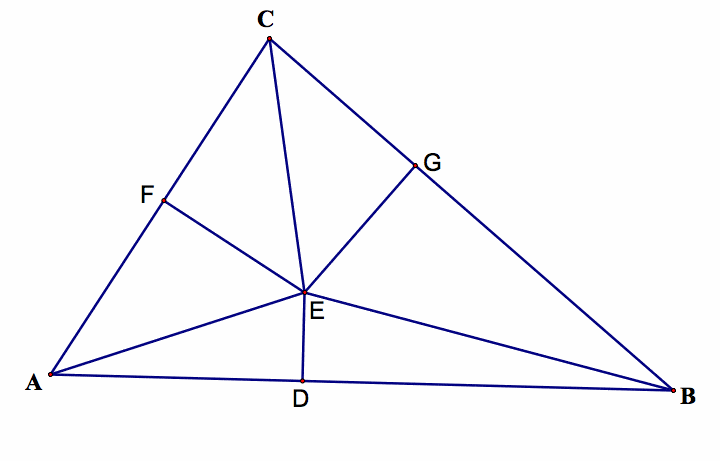
Consider an arbitrary acute triangle ABC. Let E be the intersection of the bisector at vertex C and the bisection of the side AB. Let F and G be the projections of E on AC and BC respectively.
Since E belongs to the bisection of AB, we must have AE = BE. Also, since E belongs to the bisector of C, we must have EF = EG. However, this would imply that triangles AEF and BGF are identical, and then AF = BF. We also have that CF = CG, which implies that AC = BC. The arbitrarily chosen triangle ABC is isosceles!
Can you find where the logic fails?
SOLUTION
The bisector of C and the bisection of AB always intersect outside the triangle, on the circumcircle. One of the points F and G always lies on the segment AC or BC, and the other one does not.
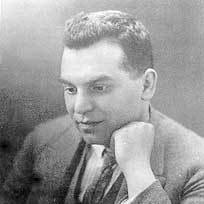
Donald “Rusty” Rust is an American artist who has created over 15000 paintings in a variety of styles. Even though he is famous mostly for his pin-up artwork, his optical illusions are some of our all-time favorites. In this special interview, he shares with us his thoughts on painting, op art, and everything which drives him forward in his long and successful career. If you like Rusty’s artwork, you can order some of it through his official store on Etsy.
Interview
Q. Hello Rusty. This is such an interesting nickname. I assume it is derived from your last name?
A. Having been born with red hair and having the name, Rust, made the nickname, “Rusty”, come easily!
Q. How did you get into painting? Was it a hard choice to devote your life to being an artist?
A. My painting career probably began one day when my grandfather, who was an artist, looked at a small drawing I had done. I must have been four or five years of age. He put me on his lap and took a drawing pencil, which he firmly pressed onto my drawing, showing me how to make my drawing more effective. Of course, that comes with confidence, something I did not yet have. My school years found me doing most of the posters within the school. After graduation, I learned that painting signs could supply enough income, so, that went on until I was about forty-nine years old. Then, I began doing portraits, which eventually led to other subject matter. No more sign painting!
Q. Apart from your grandfather, which other famous artists have inspired and influenced you?
A. Well-known pinup artist, Gil Elvgren, did work I admired. His guidance and help played a big part in the quality of my work. Bobby Toombs, Gil’s apprentice, also offered a great deal of help.
Q. Art trends have been changing a lot throughout the years. What do you think of contemporary art and how do you compare it with the more traditional art forms?
A. Times change and I welcome new ideas and styles of painting. Years ago, artists did not have projectors, air-brushes and digital images that could be altered with a click of a mouse. Always interesting!
Ambiguous optical illusion by Donald Rust
Q. You have been creating all kinds of compositions – pin-up girls, landscapes, portraits, illusions… What is the reason to be so versatile and what type of work are you currently focused on?
A. I’ve been versatile, mainly because I continually look for subject matter that “catches on”. Everything I tried provided a variety. My studies were geared primarily toward realistic painting. Over the years, my interests have changed. Now, I am doing more fantasy-type work, which allows for more creativity and originality.
Q. What is your secret for creating such amazing optical illusions? Do you first start with the hidden image and then try to conceal it, or first draw the main picture and then incorporate the illusion inside?
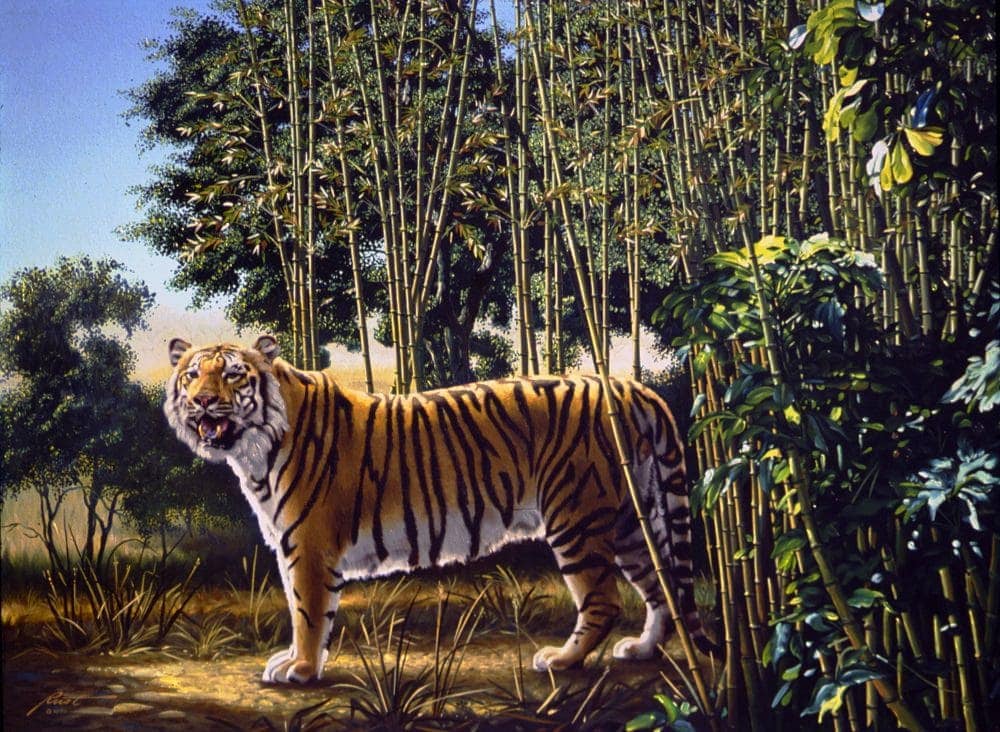
A. I have no formula for the creation of illusion images. My main concern is to mislead or trick the viewer. A good example of that is my painting, “The Hidden Tiger”, which was done when camouflage art was so popular. Viewers were accustomed to searching for an animal or something that is hidden within the scene. They could not find the hidden tiger. I had tricked them by hiding the lettering, “THE HIDDEN TIGER”, which was the stripes on the tiger. Sometimes, it is necessary to turn the image upside down to see the solution.
“The Hidden Tiger“
Q. Sounds like it requires lots of preparation and inventiveness. How much effort and time does it take to create such optical illusions, starting from the concept up until the finished product?
A. Some paintings can be done in a short length of time, while others take longer. Often, more time is spent on planning than painting. I’m usually regarded as a rather fast painter, but I spend several hours on research and planning. I try to incorporate the elements of good art… things like ideas, drawing accuracy, composition, tonal planning. color, etc.
Q. Finally, what are your hobbies and what do you like to do in your free time?
A. My free time is roaming the jungles of Florida and getting good photos of scenic and wildlife subject matter. Those photos are often used as a reference for my paintings.
Q. Sounds like a terrific pastime! Thank you for the interview Rusty. Wee don’t want to take any more of your jungle exploration time.
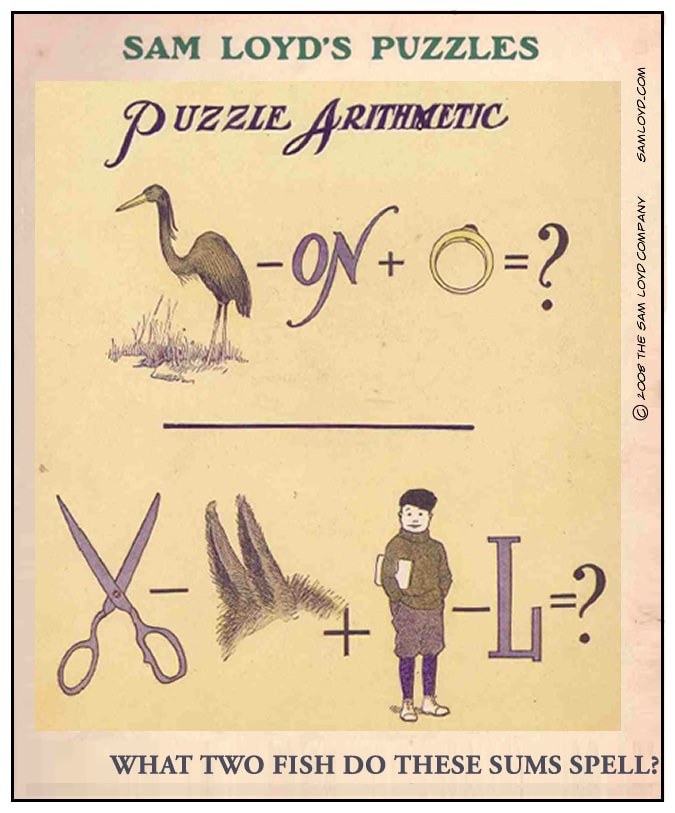
If Erica lives in New York and Tina lives in Buenos Aires, where does Mark live?
SOLUTION
New York is the largest city in the United States of Am-Erica. Buenos Aires is the largest city of Argen-Tina. Therefore Mark lives in Den-Mark’s largest city – Copenhagen.
Can you find what the following abbreviations stand for?
24 H in a D = 24 Hours in a Day 26 L of the A = ??? 7 D of the W = ??? 7 W of the W = ??? 12 S of the Z = ??? 66 B of the B = ??? 52 C in a P (W J) = ??? 13 S in the U S F = ??? 18 H on a G C = ??? 39 B of the O T = ??? 5 T on a F = ??? 90 D in a R A = ??? 3 B M (S H T R) = ??? 32 is the T in D F at which W F = ??? 15 P in a R T = ??? 3 W on a T = ??? 100 C in a R = ??? 11 P in a F (S) T = ??? 12 M in a Y = ??? 13 is U F S = ??? 8 T on a O = ??? 29 D in F in a L Y = ??? 27 B in the N T = ??? 365 D in a Y = ??? 13 L in a B D = ??? 52 W in a Y = ??? 9 L of a C = ??? 60 M in a H = ??? 23 P of C in the H B = ??? 64 S on a C B = ??? 9 P in S A = ??? 6 B to an O in C = ??? 1000 Y in a M = ??? 15 M on a D M C = ???
SOLUTION
24 H in a D = 24 Hours in a Day 26 L of the A = 26 Letters of the Alphabet 7 D of the W = 7 Days of the Week 7 W of the W = 7 Wonders of the World 12 S of the Z = 12 Signs of the Zodiac 66 B of the B = 66 Books of the Bible 52 C in a P (W J) = 52 Cards in a Pack (Without Jokers) 13 S in the U S F = 13 Stripes in the United States Flag 18 H on a G C = 18 Holes on a Golf Course 39 B of the O T = 39 Books of the Old Testament 5 T on a F = 5 Toes on a Foot 90 D in a R A = 90 Degrees in a Right Angle 3 B M (S H T R) = 3 Blind Mice (See How They Run) 32 is the T in D F at which W F = 32 Degrees is the Temperature in Fahrenheit at which Water Freezes 15 P in a R T = 15 Players in a Rugby Team 3 W on a T = 3 Wheels on a Tricycle 100 C in a R = 100 Cents in a Rand 11 P in a F (S) T = 11 Players in a Football (Soccer) Team 12 M in a Y = 12 Months in a Year 13 is U F S = 13 is Unlucky For Some 8 T on an O = 8 Tentacles on an Octopus 29 D in F in a L Y = 29 Days in February in a Leap Year 27 B in the N T = 27 Books in the New Testament 365 D in a Y = 365 Days in a Year 13 L in a B D = 13 Loaves in a Baker’s Dozen 52 W in a Y = 52 Weeks in a Year 9 L of a C = 9 Lives of a Cat 60 M in an H = 60 Minutes in an Hour 23 P of C in the H B = 23 Pairs of Chromosomes in the Human Body 64 S on a C B = 64 Squares on a Chess Board 9 P in S A = 9 Provinces in South Africa 6 B to an O in C = 6 Balls to an Over in Cricket 1000 Y in a M = 1000 Years in a Millennium 15 M on a D M C = 15 Men on a Dead Man’s Chest
Suppose you have 10 people with different heights in one row. Show that you can always remove 6 of them, so that the remaining 4 are arranged with respect to their heights (either increasing or decreasing).
SOLUTION
Mark the first person with number 1. Look for the next person after him, who is taller, and also mark him with number 1. Then look for the first person after the second one, who is taller, and also mark him with number 1. If you find a fourth one, then you already got the four people you are looking for.
If not, mark the first unmarked person with number 2. Look for the next unmarked person after him, who is taller, and also mark him with number 2. Continue with the procedure, until you either find 4 people in the line, whose heights are increasing, or have people who are marked with numbers 1, 2, 3 and 4.
Now pick a person, who is marked with number 4. Then look for the closest person on the left, who is marked with number 3, pick him up. He will be taller, because otherwise the first person would have been labeled 3 as well. Similarly, look for the closest person, marked with 2, on the left of the last one, pick him up. Repeat this once again and you will find 4 people in the line, whose heights are decreasing.
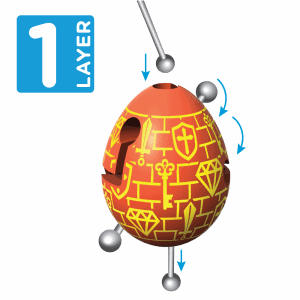
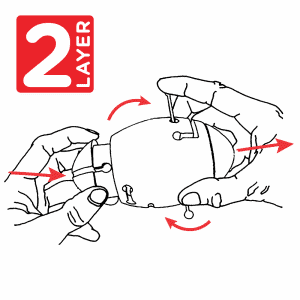
Smart Eggs are maze type puzzles created by the Hungarian inventor Andras Zagyvai. The basic idea is to navigate a plastic stick from the top of an egg to its bottom, pushing, pulling and moving the stick around various holes and tunnels carved in it.
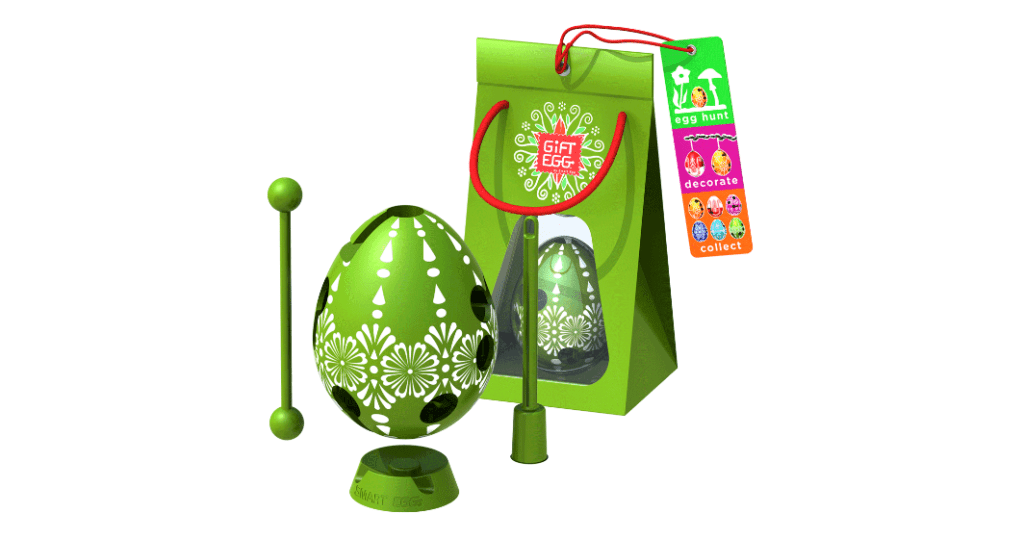
The original six 1-layer Smart Eggs are extremely simple to solve and targeted towards very young children. There is only one natural path the stick can take, and you simply have to follow it. The eggs are also fairly small and initially may look a bit underwhelming. The designs, however, are beautiful, and the construction is solid. Despite the low difficulty level and lack of hard challenges, the 1-layer Smart Eggs are fun to play and fidget with, both for kids and adults. Collecting them all results in a wonderful shelf collection.
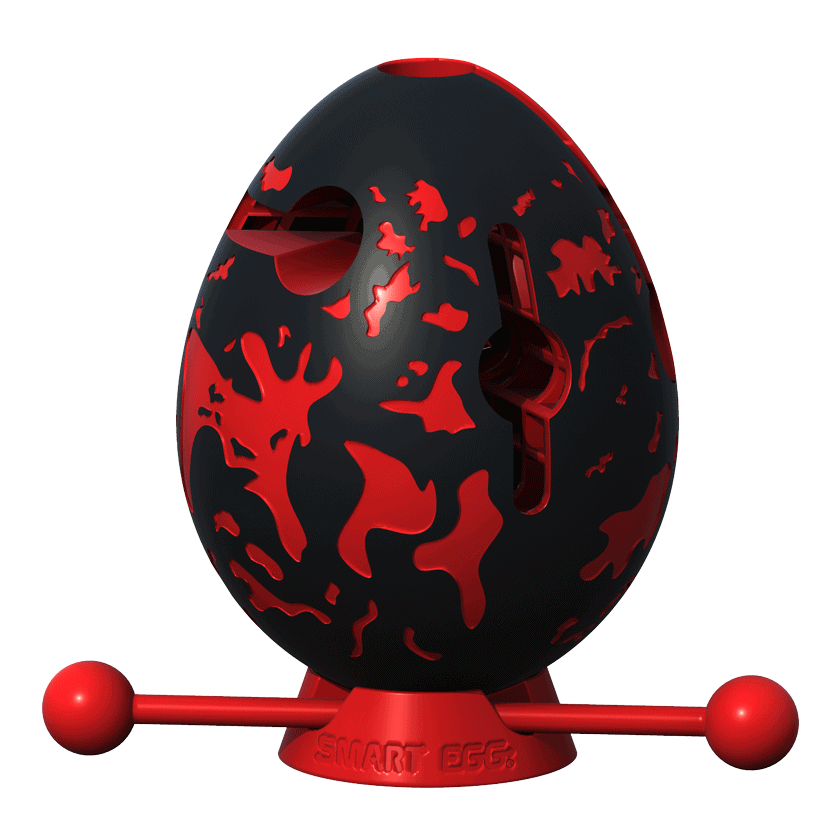
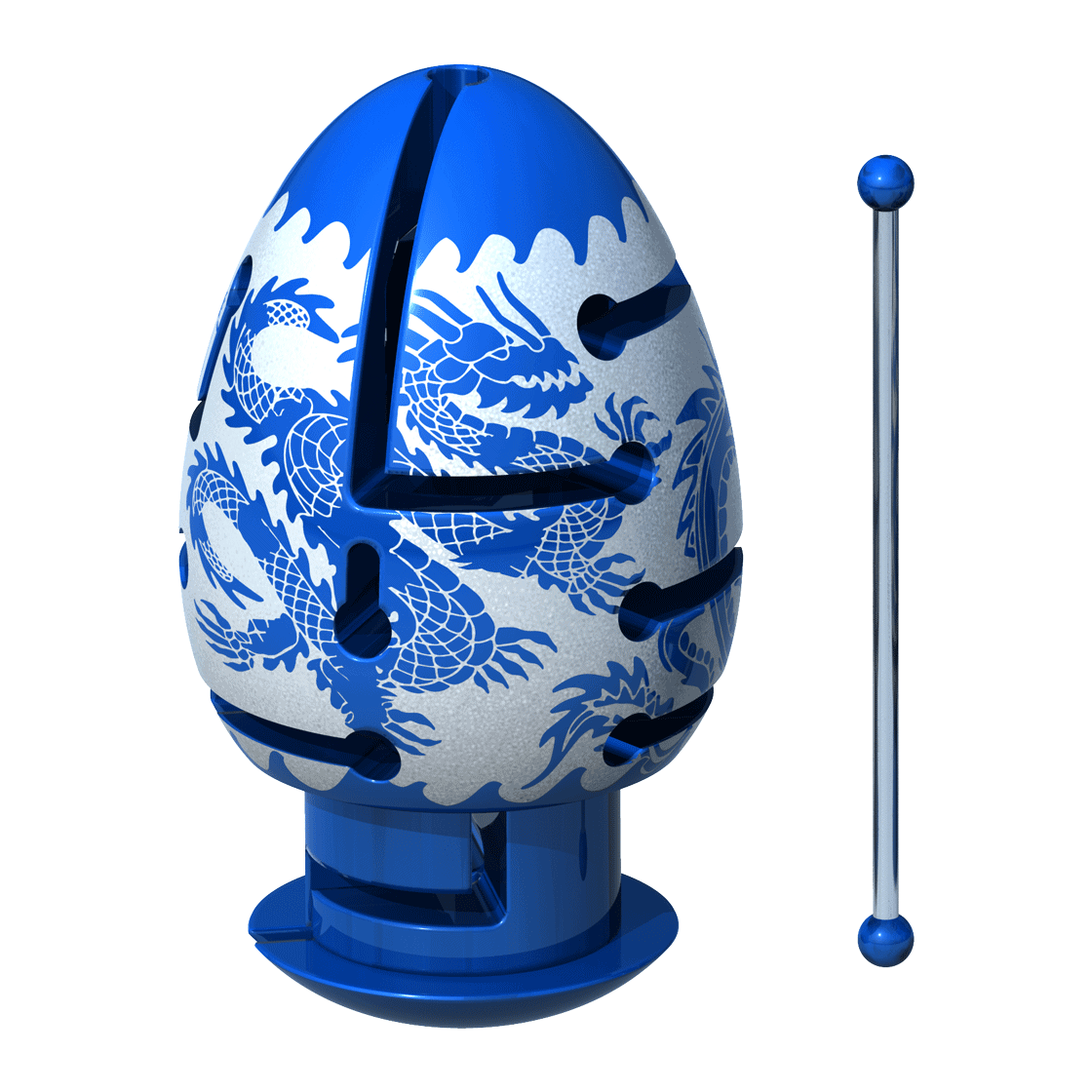
The 2-layer Smart Eggs are the bigger, better, harder version of the original 1-layer Smart Eggs. The goal remains the same – navigate a stick from the top of the egg to its bottom. The collection consists of three Dragon Eggs – blue, red, and black, listed according to their difficulty level. The first thing which makes impression is the beautiful art – on every egg there are three dragons depicted, no two of them the same. These toys have much higher quality than the original Smart Eggs – they are around twice the size, come with metal sticks, plastic stands, and much more intricate designs. Inside every egg there is a core which can rotate and also slide up and down, creating many possibilities for the stick’s movement. Even though the blue egg is fairly straightforward to solve, the red and the black ones can pose a real challenge. The 2-layer Smart Eggs have high replay value, and you will probably find yourself coming regularly back to them. They are fun, smart, and highly recommended puzzles.
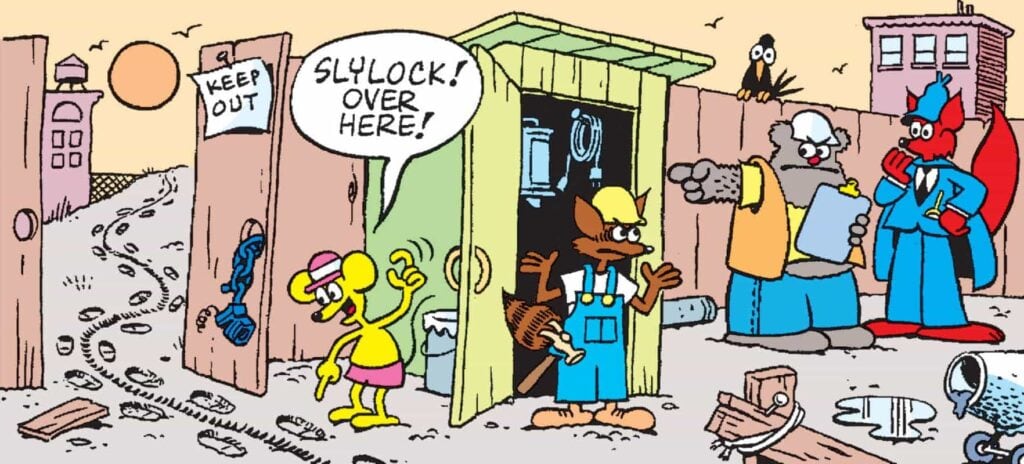
Tools were stolen from a construction site. Max Mouse found footprints and a tire track, leading him to believe there were two thieves – one walking and the other riding a bike. Even though Slylock Fox believes both tracks are related to the robbery, he suspects there was only one thief. Why?
SOLUTION
The tire track cannot be from a bike. The tracks were left by one thief pushing a wheelbarrow, full of stolen tools.
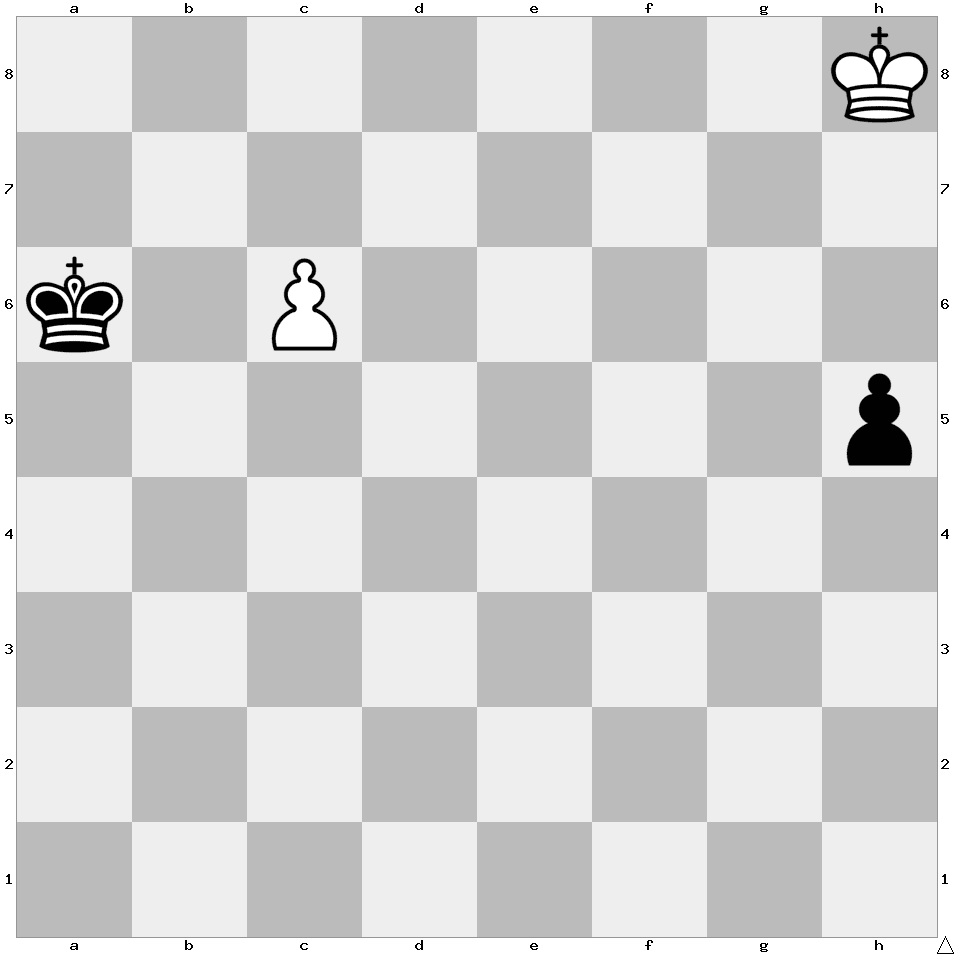
It is White’s move next. Is this game a win for Black or a draw?
SOLUTION
The game is a draw. The first two moves of White are Kg7 and Kf6. If Black moves the king twice in the meantime, then White can get to the pawn on the h-file and take it. If Black moves the king once, then White plays Ke5. If Black moves the king again, White can take the pawn on the h-file. Otherwise, White plays Kd6 and can promote his pawn right after Black promotes his. Finally, if after Kg7 and Kf6 Black moves the pawn twice, then White plays Ke7, and once again can promote his pawn right after Black promotes his.