
Self-Describing Number

Find all 10-digit numbers with the following property:

  • the first digit shows the number of 0s in the number
  • the second digit shows the number of 1s in the number
  • the third digit shows the number of 2s in the number, and so on

Let the number be ABCDEFGHIJ. The number of all digits is 10:

A + B + C + D + E + F + G + H + I + J = 10

Therefore, the sum of all digits is 10. Then:

0×A + 1×B + 2×C + 3×D + 4×E + 5×F + 6×G + 7×H + 8×I + 9×J = 10

We see that F, G, H, I, J < 2. If H = 1, I = 1, or J = 1, then the number contains at least 7 identical digits, clearly 0s. We find A > 6 and E = F = G = 0. It is easy to see that this does not lead to solutions, and then H = I = J = 0.

If G = 1, we get E = F = 0. There is a 6 in the number, so it must be A. We get 6BCD001000, and easily find the solution 6210001000.

If G = 0, F can be 0 or 1. If F = 1, then there must be a 5 in the number, so it must be A. We get 5BCDE10000. We don’t find any solutions.

If F = 0, then the number has at least five 0s, and therefore A > 4. However, since F = G = H = I = J = 0, the number does not have any digits larger than 4, and we get a contradiction.

Thus, the only solution is 6210001000.

FEATURED

Five Points in a Square

There are 5 points in a square 1×1. Show that 2 of the points are within distance 0.75.

Split the unit square into 4 small squares with side lengths 0.5. At least one of these squares will contain 2 of the points. Since the diagonals of the small squares have lengths less than 0.75, these 2 points must be within such distance.

Fish in a Pond

There are 5 fish in a pond. What is the probability that you can split the pond into 2 halves using a diameter, so that all fish end up in one half?

Let us generalize the problem to N fish in a pond. We can assume that all fish are on the boundary of the pond, which is a circle, and we need to find the probability that all of them are contained within a semi-circle.

For every fish Fᵢ, consider the semi-circle Cᵢ whose left end-point is at Fᵢ. The probability that all fish belong to Cᵢ is equal to 1/2ᴺ⁻¹. Since it is impossible to have 2 fish Fᵢ and Fⱼ, such that the semi-sircles Cᵢ and Cⱼ contain all fish, we see that the probability that all fish belong to Cᵢ for some i is equal to N/2ᴺ⁻¹.

When N = 5, we get that the answer is 5/16.

Pronunciation Puzzles

The following 2 puzzles rely on misleading phrasing of the questions. Read them aloud to your friends and let them ponder upon them.

  1. What has 4 letters, sometimes 9, and never 5
  2. One night a king and a queen stayed in a hotel. On the next day, three people checked out. Who was the third person?
  3. There are 30 cows and 28 chickens. How many didn’t?
  4. Pronounce the following words: T-W-A, T-W-E, T-W-I, T-W-O
  5. As I was walking across the London Bridge, I met a man.
    He tipped his hat, and drew his cane.
    In this riddle, I said his name. What is it?

The first puzzle is not a question. It is a statement, saying that the word “what” has 4 letters, the word “sometimes” has 9 letters, and the word “never” has 5 letters. There is nothing to solve, so the puzzle is figuring that out!

The second puzzle reads as “One knight, a king, and a queen stayed in a hotel.” Thus, the third person was the knight.

The third puzzle reads as “There are 30 cows and 20 ate chickens. How many didn’t?” Thus, the answer is that 10 cows didn’t eat chickens.

The fourth question often confuses people and they pronounce TWO as [twou] instead of [tuː].

The fifth riddle actually says: “He tipped his hat, ‘Andrew Hiscane'”. Thus, the name of the man is Andrew Hiscane.

Rapunzel and the Prince

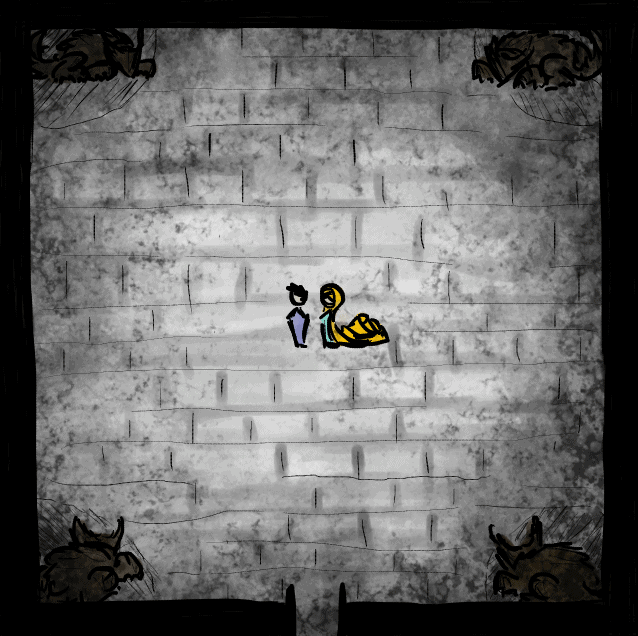
The evil witch has left Rapunzel and the prince in the center of a completely dark, large, square prison room. The room is guarded by four silent monsters in each of its corners.  Rapunzel and the prince need to reach the only escape door located in the center of one of the walls, without getting near the foul beasts. How can they do this, considering they can not see anything and do not know in which direction to go?

The prince must stay in the center of the room and hold Rapunzel’s hair, gradually releasing it. Then, Rapunzel must walk in circles around the prince, until she gets to the walls and finds the escape door.

Hungry Lion

A hungry lion runs inside a circus arena which is a circle of radius 10 meters. Running in broken lines (i.e. along a piecewise linear trajectory), the lion covers 30 kilometers. Prove that the sum of all turning angles is at least 2998 radians.

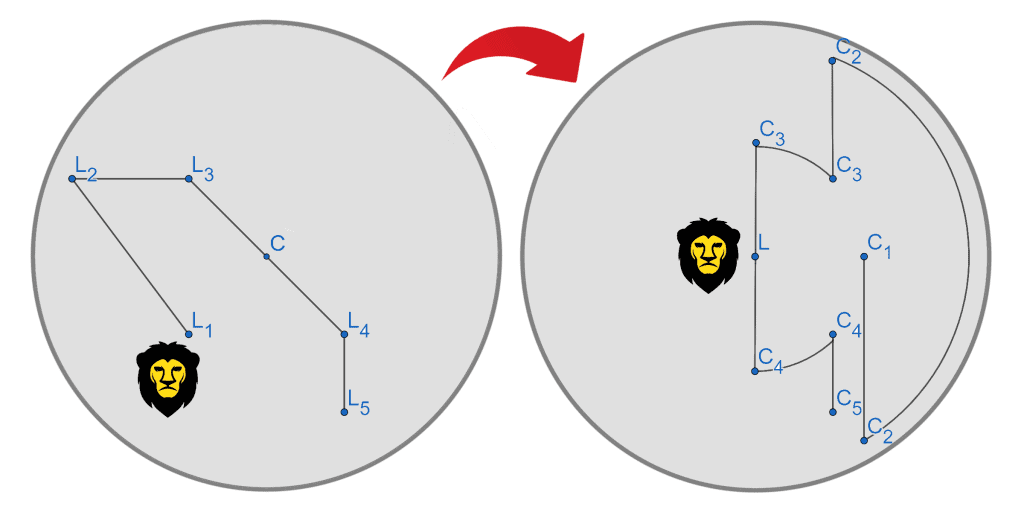
Imagine the lion is static, facing North, and instead, the center of the arena moves around. Then, each time the lion runs X meters in some direction, this translates into the center moving X meters South. Each time the lion makes a turn of Y radians, this translates into the center moving along an arc of Y radians.

Thus, the problem translates to a point inside the arena alternating between traveling straight South and then moving along arcs around the center of the arena. Since the total distance traveled straight South by the point is 30KM and the distance between the starting and the ending points is at most 20M, the total distance traveled North must be at least 30KM – 20M = 29980M. Therefore, the total length of the arcs traversed by the point is at least 29980M, and since the radius of each arc is at most 10M, the total angle of the arcs must be at least 2998 radians. The sum of all turning angles of the lion is the same, so this concludes the proof.

FEATURED

Houses on a Farm

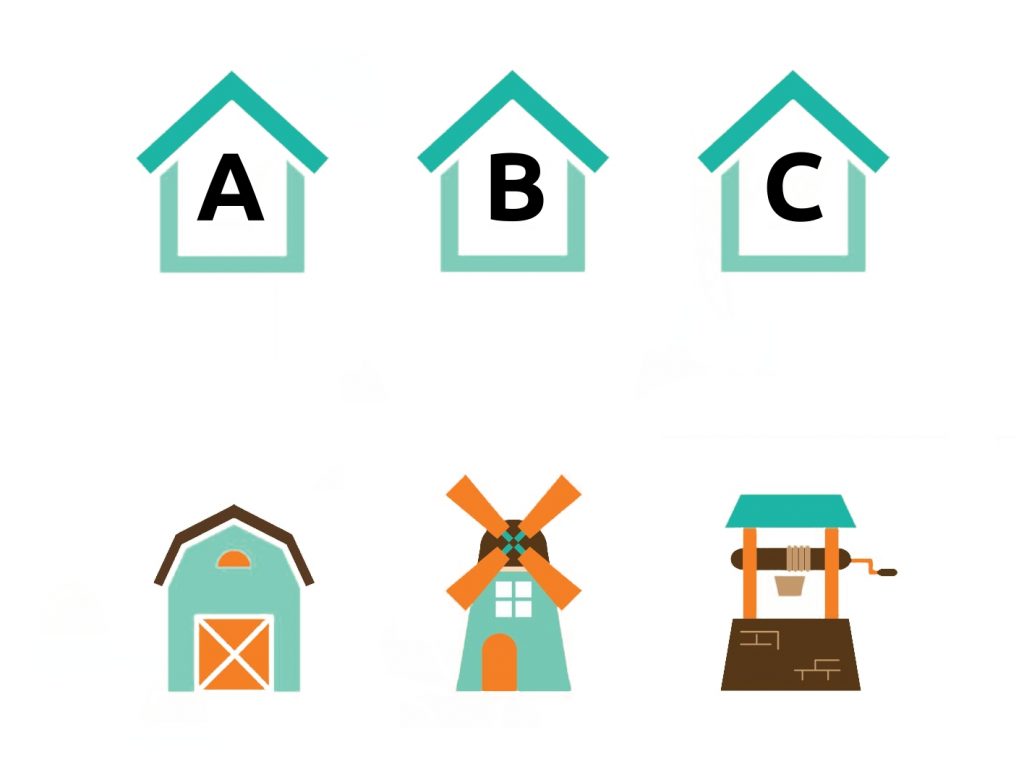
Is it possible to connect each of the houses with the well, the barn, and the mill, so that no two connections intersect each other?

No, it is impossible. Here is a convincing, albeit a informal proof.

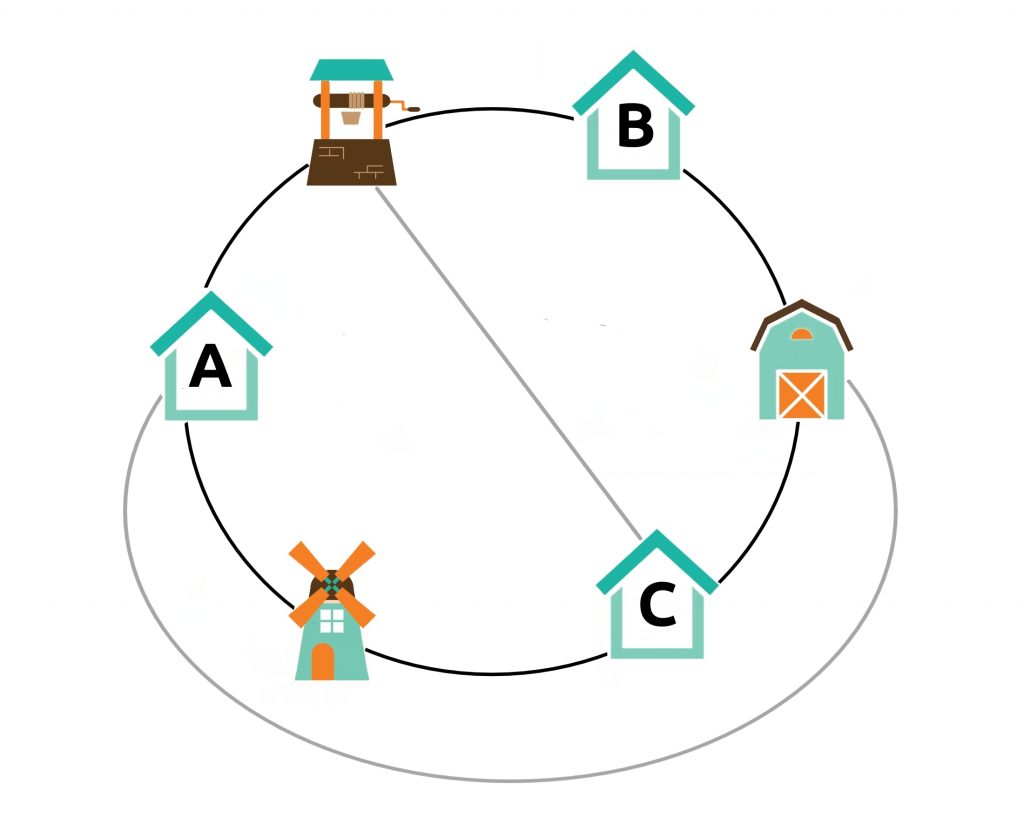
Imagine the problem is solvable. Then you can connect House A to the Well, then the Well to House B, then House B to the Barn, then the Barn to House C, then House C to the Mill, and finally the Mill to House A. Thus, you will create one loop with 6 points on it, such that houses and non-houses are alternating along the loop. Now, you must connect Point 1 with Point 4, Point 2 with Point 5, Point 3 with Point 6, such that the three curves do not intersect each other. However, you can see that you can draw no more than one such curve neither on the inside, nor the outside of the loop. Therefore, the task is indeed impossible.

More rigorous, mathematical proof can be made using Euler’s formula for planar graphs. We have that F + V – E = 2, where F is the number of faces, V is the number of vertices, and E is the number of edges in the planar graph. We have V = 6 and E = 9, and therefore F = 5. Since no 2 houses or 2 non-houses can be connected with each other, every face in this graph must have at least 4 sides (edges). Therefore, the total number of sides of all faces must be at least 20. However, this is impossible, since every edge is counted twice as a side and 20/2 > 9.